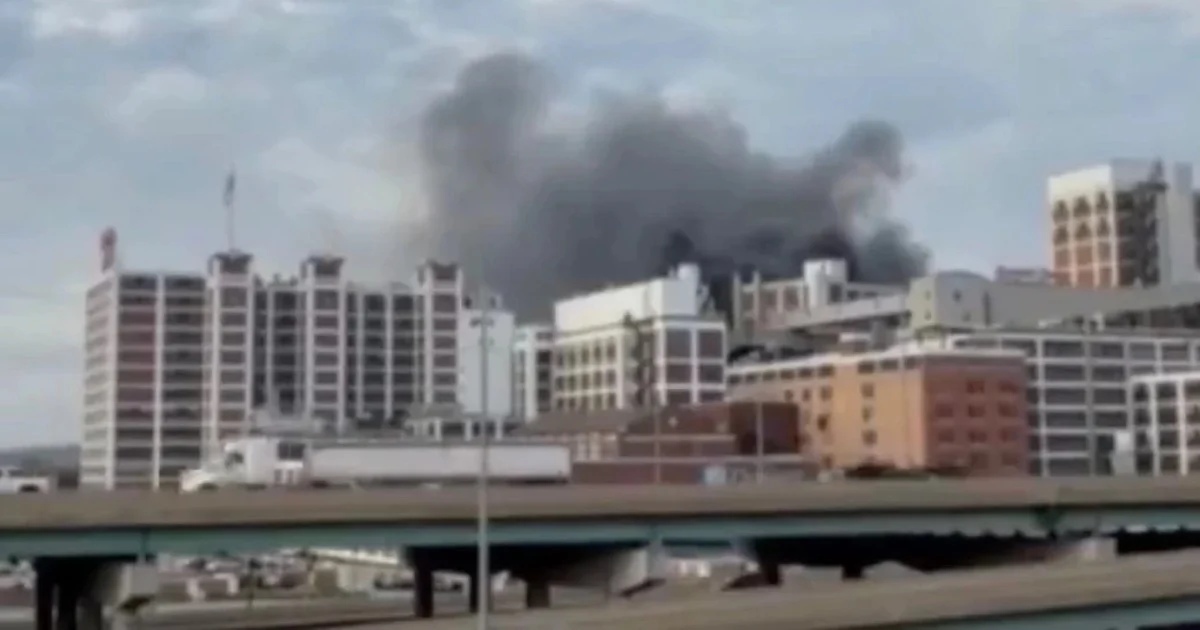
A significant industrial incident unfolded on Saturday, October 24, 2026, when a major fire erupted at the Quaker Oats facility in downtown Cedar Rapids, Iowa, following reports of an explosion. The incident prompted a large-scale emergency response, drawing numerous fire and rescue units to the scene and causing substantial traffic disruptions in the heart of the city. The towering plumes of smoke, visible from miles away, quickly became a stark symbol of the unfolding crisis at one of Cedar Rapids’ most recognizable landmarks.
Chronology of the Catastrophe
The initial reports of an explosion at the historic Quaker Oats plant began circulating shortly before 4:00 PM local time. Witnesses in the downtown area described a powerful blast that shook nearby buildings, followed almost immediately by the rapid escalation of a fire within a section of the massive facility. Emergency services were notified without delay, and within minutes, the Cedar Rapids Fire Department (CRFD) dispatched multiple engine companies, ladder trucks, and support units to the site located at 616 2nd Street NE.
Local ABC affiliate KCRG-TV was among the first news outlets to report from the scene, capturing dramatic footage of a dense, dark column of smoke billowing into the sky, indicative of a significant blaze. Social media platforms were quickly inundated with images and videos from residents and passersby, showcasing the intensity of the fire and the sheer scale of the emergency response. Insider Paper and Scope Report, among others, shared real-time updates and visuals of the unfolding disaster, underscoring the immediate public concern.
Within the first hour of the incident, a critical update emerged that brought a wave of relief amidst the chaos: the Cedar Rapids Fire Department confirmed that all plant workers had been accounted for. This crucial announcement alleviated fears of potential fatalities or serious injuries, shifting the focus to containment and investigation. However, early visual evidence from online posts and news reports indicated that the section of the facility where the fire originated had sustained substantial structural damage, suggesting a prolonged recovery and rebuilding effort.
Emergency Response and Public Safety Measures
The emergency response was comprehensive and multi-faceted, involving not only the Cedar Rapids Fire Department but also local police, Linn County Sheriff’s Office, and emergency medical services. Streets surrounding the Quaker Oats complex, including major arteries, were immediately cordoned off to facilitate the movement of emergency vehicles and ensure public safety. Traffic diversions were put in place, leading to significant congestion throughout the downtown area and impacting weekend activities.
Firefighters battled the intense blaze for several hours, deploying multiple hose lines and aerial ladders to douse flames from various angles. The strategic location of the plant, nestled within the urban core, presented unique challenges for emergency crews, necessitating careful consideration of adjacent structures and potential environmental impacts. Public advisories were issued urging residents to avoid the area and, in some cases, to keep windows closed due to smoke inhalation concerns. Air quality monitoring units were reportedly deployed to assess potential particulate matter and other airborne contaminants. The coordinated effort of first responders was instrumental in preventing the fire from spreading to other parts of the sprawling complex or to neighboring businesses and residences.
The Quaker Oats Facility: A Historical and Economic Pillar
The Quaker Oats plant in Cedar Rapids is not merely a manufacturing facility; it is a cornerstone of the city’s industrial heritage and a significant employer. Established in the late 19th century, the plant has operated for well over a century, becoming the largest oat milling facility in the world. It processes vast quantities of oats, transforming them into a myriad of products, including Quaker Oatmeal, Cap’n Crunch, and Quaker Chewy granola bars, which are distributed globally. The facility’s iconic silos and brick buildings are a recognizable feature of the Cedar Rapids skyline, symbolizing the city’s deep roots in agriculture and food processing.
Cedar Rapids itself is known as the "City of Five Seasons" and boasts a robust industrial sector, particularly in the food processing and agricultural technology industries. Companies like Cargill, ADM, and General Mills also have a significant presence, making the city a vital hub for America’s food supply chain. The Quaker Oats plant, with its hundreds of employees, contributes substantially to the local economy through wages, taxes, and indirect support for numerous ancillary businesses. An incident of this magnitude at such a pivotal facility inevitably sends ripples through the local community and beyond.
Understanding Industrial Risks: The Specter of Dust Explosions
While the official cause of the explosion and fire at the Quaker Oats plant remains under investigation, incidents of this nature in food processing facilities often raise concerns about specific industrial hazards, particularly dust explosions. Grain dust, flour dust, sugar dust, and other combustible organic materials commonly found in food processing environments can, under specific conditions, become highly explosive.
A dust explosion requires a precise combination of five elements, often referred to as the "dust explosion pentagon":
- Fuel: Combustible dust particles.
- Dispersion: Dust suspended in the air in sufficient concentration.
- Oxidizer: Oxygen in the surrounding atmosphere.
- Confinement: An enclosed space where pressure can build.
- Ignition Source: A spark, hot surface, open flame, static electricity, or even friction.
If these conditions are met, a primary explosion can occur, which can then dislodge accumulated dust in other areas, leading to a much larger and more destructive secondary explosion. The Occupational Safety and Health Administration (OSHA) has stringent standards and guidelines (e.g., OSHA 1910.272 for grain handling facilities) aimed at preventing such incidents, emphasizing proper housekeeping to minimize dust accumulation, effective ventilation systems, and control of ignition sources. According to OSHA data, combustible dust hazards are present in a wide variety of industries and contribute to numerous industrial accidents annually, highlighting the persistent challenge of managing these risks. The National Fire Protection Association (NFPA) also publishes comprehensive standards (e.g., NFPA 652: Standard on Fundamentals of Combustible Dust) that facilities are encouraged to adopt to mitigate these dangers.
Investigations into such industrial incidents typically involve a thorough examination of equipment, operational procedures, maintenance records, and witness accounts. The findings often lead to updated safety protocols and, in some cases, regulatory changes aimed at preventing future occurrences.

Official Statements and Community Reactions
Following the incident, Republican Iowa Senator Chuck Grassley was quick to acknowledge the severity of the situation and offer his support. In a post on X (formerly Twitter), Senator Grassley stated, "I’ve just been alerted to the fire in Cedar Rapids at Quaker Oats. I’m praying for the safety of those in or near the building and for the first responders on the scene." This sentiment was widely echoed by local officials and community members, all expressing relief that no workers were reported injured and solidarity with those affected.
While formal statements from Quaker Oats corporate headquarters were anticipated, a typical response would emphasize the company’s commitment to employee safety, full cooperation with investigating authorities, and an immediate assessment of the damage and operational impact. Such statements often underscore a dedication to supporting affected employees and the local community during recovery.
Local authorities, including the Cedar Rapids Police Department and city officials, were expected to provide ongoing updates regarding traffic management, public safety advisories, and the progress of the investigation. The city’s emergency management agency would likely coordinate long-term recovery efforts, including environmental monitoring and support for displaced workers.
The incident also resonated deeply within the Cedar Rapids community, which has a strong connection to the Quaker Oats brand. Many residents have family members or friends who have worked at the plant over generations. The images of smoke billowing from the historic facility evoked a mix of shock, concern, and a collective hope for a swift and safe resolution.
Broader Implications: Economic, Supply Chain, and Environmental Concerns
The fire and explosion at the Quaker Oats plant carry significant implications that extend beyond the immediate emergency response.
Economic Impact
For Cedar Rapids, the immediate economic impact centers on the hundreds of employees whose workplaces have been directly affected. While their safety was paramount, the disruption to operations will inevitably raise questions about job security, temporary layoffs, and the long-term future of the plant. Local businesses that rely on the plant for supply chain activities or employee patronage will also feel the ripple effect. Rebuilding efforts, though costly, could also inject temporary economic activity through construction and related services.
Supply Chain Disruptions
As the world’s largest oat milling facility, the Quaker Oats plant plays a critical role in the global food supply chain for numerous products. A prolonged shutdown could lead to disruptions in the availability of popular breakfast cereals, oat-based ingredients, and other Quaker Oats products. While multinational corporations often have contingency plans and alternative production sites, shifting production can take time and may incur additional costs, potentially impacting product availability and pricing for consumers. This incident underscores the fragility of complex supply chains, particularly for essential goods like food.
Environmental Considerations
The large-scale industrial fire also raises environmental concerns. The immediate air quality impact from the smoke plume, containing particulate matter and potentially other combustion byproducts, was a primary concern for residents in the immediate vicinity. While initial advisories focused on avoiding the area and keeping windows closed, ongoing monitoring would be necessary to assess any long-term effects. Additionally, the runoff from firefighting efforts could introduce contaminants into local water systems, requiring careful management and environmental mitigation strategies. The Iowa Department of Natural Resources (DNR) would likely be involved in assessing and managing these potential environmental impacts.
Regulatory Scrutiny
Incidents of this magnitude invariably trigger intense scrutiny from regulatory bodies such as OSHA and the Environmental Protection Agency (EPA). Investigators will meticulously review safety protocols, maintenance records, compliance with federal and state regulations, and the circumstances leading to the explosion and fire. Any identified deficiencies could lead to enforcement actions, fines, and mandates for corrective measures, setting precedents for other industrial facilities.
The Road Ahead: Investigation and Rebuilding
The path forward for the Quaker Oats plant and the Cedar Rapids community will involve a multi-pronged approach. A comprehensive investigation, led by fire marshals, industrial safety experts, and potentially federal agencies, will be crucial to determine the precise cause of the explosion and fire. This investigation will be exhaustive, involving structural engineers, chemical experts, and forensic analysis to reconstruct the events that led to the disaster. The findings will be vital not only for accountability but also for implementing enhanced safety measures to prevent similar incidents in the future.
Simultaneously, Quaker Oats will face the immense task of assessing the full extent of the damage, planning for reconstruction, and determining the operational future of the Cedar Rapids facility. Given its historical significance and strategic importance, a commitment to rebuilding is often a strong possibility, though the timeline and scope of such an undertaking would be considerable.
The resilience of Cedar Rapids, a city that has overcome natural disasters like the devastating 2008 flood, suggests a strong capacity for recovery. The community, employees, and corporate leadership will undoubtedly work together to navigate the challenges ahead, aiming to restore the Quaker Oats plant to its former operational glory while prioritizing enhanced safety for all. The incident serves as a stark reminder of the inherent risks in industrial operations and the constant vigilance required to protect lives, livelihoods, and critical infrastructure.