

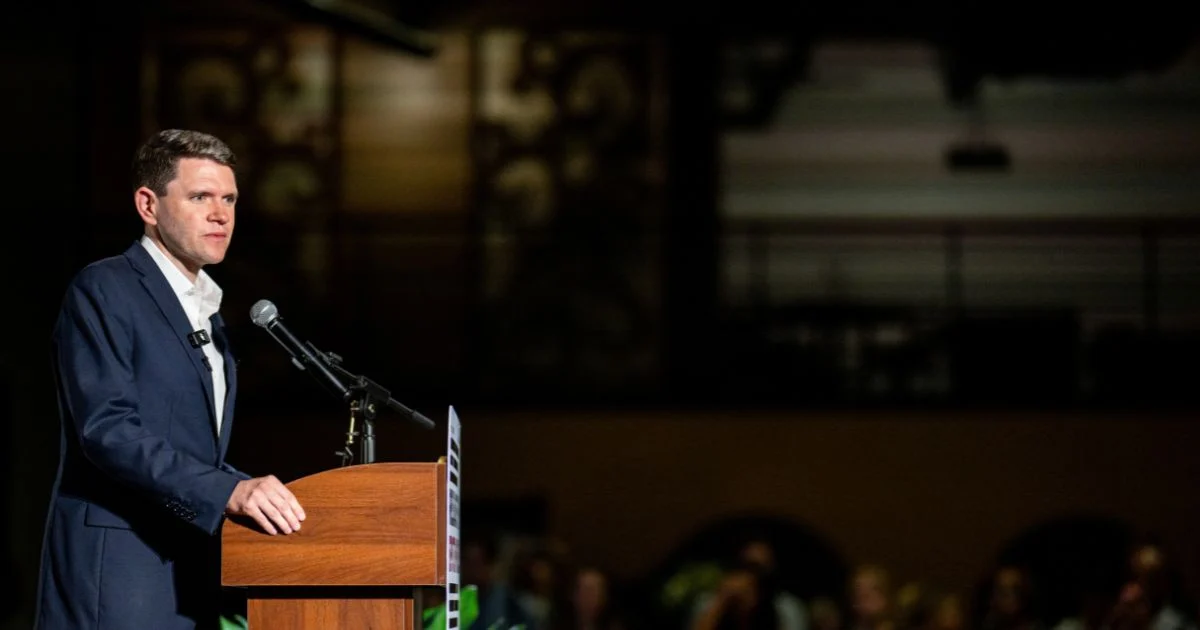
The Texas Democratic Senate candidate, James Talarico, has plunged his high-stakes campaign into turmoil following a mysterious multi-day disappearance from the campaign trail, which has since been characterized by conflicting explanations regarding his health and an explosive, though officially denied, allegation of hospitalization for mental health treatment. Talarico’s unexpected hiatus and the subsequent inconsistencies in his public statements have ignited a firestorm of scrutiny from political rivals, media outlets, and concerned voters, raising serious questions about transparency, trustworthiness, and a candidate’s fitness for public office in the intense run-up to a pivotal Senate election.
The Initial Disappearance and Virtual Appearance
The controversy first surfaced around September 30, 2026, when James Talarico, a prominent figure in the Texas Democratic Party and a hopeful for the U.S. Senate, failed to appear in person at a crucial forum hosted by the U.S. Hispanic Business Council. His absence immediately drew attention, particularly given the critical stage of the campaign. Instead of an in-person appearance, Talarico participated virtually, addressing the audience remotely. During this virtual address, he offered his initial explanation for his unexpected absence: a sudden bout of influenza.
"I was starting to feel kind of under the weather a few days ago, and last night it got so bad that I went to the urgent care here in Dallas, and I was diagnosed with the flu," Talarico stated during the forum. This explanation, while seemingly straightforward, would soon become the subject of intense debate and fact-checking, laying the groundwork for the ensuing political drama. The initial communication from his campaign team during this period was sparse, fueling speculation and concern about the candidate’s whereabouts and well-being. Campaign strategists often emphasize the importance of a candidate’s visible presence, especially in competitive races, making Talarico’s disappearance particularly conspicuous and politically damaging.
A Return to the Spotlight and Shifting Narratives
After several days of being "missing in action" from public view and campaign events, Talarico finally re-emerged on the campaign trail on Friday, October 9, 2026. His return, however, did little to quell the mounting questions; instead, it ushered in a new wave of scrutiny as his narrative regarding his illness began to show inconsistencies.
On Sunday, October 11, Talarico granted an interview to Phil Prazan of NBC News, a highly anticipated conversation intended to clarify the events of the preceding days. During this interview, Prazan pressed Talarico on the severity of his illness, particularly in light of the candidate’s previously disclosed diabetes diagnosis. "How bad was it, for somebody who wants to know?" Prazan inquired. "Is this just, like, in-bed rest, or did you ever have to go to a doctor or a hospital?"

Talarico’s response diverged significantly from his earlier account. "I just went to my primary care physician, but it wasn’t anything worse than a nasty case of the flu, and so I was in bed and drinking lots of liquids," he explained. This statement immediately raised red flags for many observers. The contradiction between "urgent care" — a facility typically sought for immediate, acute medical needs — and "primary care physician" — a regular, personal doctor for routine health management — was stark. This discrepancy was quickly highlighted by opposing political entities, notably RNC Research, which posted on X (formerly Twitter): "James Talarico 2 weeks ago: ‘I went to the urgent care here in Dallas.’ Now he’s saying he only visited his primary care physician. What is Talarico hiding?"
The Mental Health Allegation and Hospital’s Denial
Adding another layer of profound complexity and controversy to the unfolding narrative was a shocking audio recording released on Sunday, October 11, by conservative investigative journalist Nick Sortor. In the recording, Sortor claimed to have obtained confirmation that Talarico had recently been discharged from a mental health facility. The recording featured a woman, identified by Sortor as a receptionist for the Lindner Center of Hope in Mason, Ohio, purportedly stating that Talarico "was just discharged this evening."
Sortor accompanied the audio with a highly critical post on X, asserting, "The ‘flu’ thing was a BIG FAT LIE." He further elaborated that a hospital employee had told him and his colleague, Rhein Amacher, that Talarico "had in fact been a patient at the Lindner Center of Hope near Cincinnati, Ohio, which specializes in around-the-clock mental health treatment." Sortor’s post concluded with a strong condemnation of Talarico’s perceived suitability for office, stating, "While I sympathize with those dealing with mental health crises, this man is CLEARLY not suited to become a US Senator representing over 30 MILLION TEXANS. The job doesn’t get easier after being elected — it only gets MORE stressful. And Talarico clearly can’t handle it."
The severity of this allegation, particularly its implications for a public figure seeking a demanding national office, sent shockwaves through the political landscape. However, the Lindner Center of Hope swiftly moved to counter Sortor’s claim. Later that same day, the hospital issued an official statement on its X account, directly refuting the assertion: "Representative James Talarico has never received treatment from Lindner Center of Hope." This unequivocal denial from the institution itself introduced a profound conflict of facts, leaving the public to grapple with conflicting reports from a prominent journalist and a reputable medical facility.
Reactions, Scrutiny, and Campaign Implications
The public and political reactions to these developments have been varied and intense. Talarico’s defenders have attempted to reconcile the conflicting medical accounts, suggesting a plausible, albeit unconfirmed, timeline where he might have initially visited an urgent care facility while on the campaign trail and subsequently seen his personal primary care physician upon returning home. This explanation, however, has failed to satisfy many skeptics, who point to the initial vagueness of Talarico’s absence and the specific wording of his different statements.
Social media users, as evidenced by replies to Phil Prazan’s interview and Sortor’s post, have expressed deep skepticism. Comments such as "@PhilPrazan Talarico is clearly lying. He is clearly nervous and sweating," and "@PhilPrazan @earlyvotedata Did he provide any proof? Documentation from a doctor? Not one photo from staff?" highlight the public’s demand for greater transparency and verifiable evidence. The absence of concrete medical documentation or consistent statements from Talarico’s campaign has only intensified these doubts.

From a campaign strategy perspective, the implications for Talarico are significant. Trust and transparency are paramount in political campaigns, and any perception of dishonesty or obfuscation can severely damage a candidate’s credibility. The questions surrounding his health, whether physical or mental, raise concerns among voters about his stamina, resilience, and capacity to handle the immense pressures of a U.S. Senate seat, which involves rigorous legislative work, constant public scrutiny, and the responsibility of representing millions of constituents. Opposing campaigns are almost certain to leverage these controversies to cast doubt on Talarico’s character and suitability for office, painting a picture of a candidate who is either dishonest or incapable of handling pressure.
Broader Context: Health and Transparency in Modern Politics
The controversy surrounding James Talarico is not isolated but rather reflects a recurring tension in modern politics: the balance between a public figure’s right to privacy and the public’s right to know about a candidate’s health. Historically, the health of presidential and senatorial candidates has often been a subject of intense scrutiny, from Grover Cleveland’s secret cancer surgery to John F. Kennedy’s undisclosed health issues. In an age of instant information and social media, this scrutiny is amplified, and demands for transparency are higher than ever.
Voters often view a candidate’s health, both physical and mental, as an indicator of their ability to perform the demanding duties of public office. Questions about a candidate’s mental well-being, in particular, carry significant weight, though they are often handled with sensitivity due to the stigma still associated with mental health issues. The incident highlights the delicate tightrope walk candidates must perform: addressing health concerns openly enough to build trust, yet protecting personal privacy.
Furthermore, this episode underscores the powerful and often disruptive role of digital media and independent journalists in shaping political narratives. Nick Sortor’s audio recording, regardless of its ultimate veracity, immediately became a major talking point, demonstrating how quickly unverified or disputed claims can spread and influence public perception. The rapid denial from the Lindner Center of Hope also illustrates the need for institutions to be agile in responding to online allegations, especially when their reputation or the privacy of individuals is at stake. The fragmented information environment makes it challenging for voters to discern factual accuracy from politically motivated assertions, placing a greater burden on individuals to critically evaluate sources.
Conclusion: Unresolved Questions and a Campaign Under Duress
As of October 12, 2026, the situation surrounding James Talarico remains fraught with unresolved questions. The core discrepancies in his accounts of medical care, coupled with the serious mental health allegations and the hospital’s direct denial, have created a complex and deeply troubling narrative for his campaign. Voters are left to weigh conflicting statements and assess the credibility of various sources, all while a critical Senate race hangs in the balance.
The coming days and weeks will undoubtedly test Talarico’s ability to navigate this crisis. His campaign will need to provide a coherent, consistent, and verifiable account of his absence and health, potentially offering documentation or more detailed explanations to quell the swirling rumors and rebuild public trust. Failure to do so could prove fatal to his aspirations for the U.S. Senate, as the perception of a lack of transparency or trustworthiness can be one of the most damaging blows a political campaign can suffer. The Texas Senate race, already a focal point of national political attention, has now become a crucible for the issues of candidate transparency, public scrutiny, and the complex interplay of health and political leadership in the digital age.








