Kiowa Gordon, the acclaimed star of AMC’s hit Native American noir thriller Dark Winds, embodies a fascinating duality: a serious actor whose profound performances resonate deeply with audiences, yet off-screen, he’s known as the effervescent "class clown" on set. This playful spirit, characterized by cracking jokes, orchestrating pranks, and setting the mood with a portable boombox, can instantly transform into intense focus for a dramatic scene, a testament to his remarkable range. This chameleon-like adaptability extends beyond his acting, profoundly shaping his experimental and eclectic personal style, which, much like his personality, steadfastly defies conventional definition.
At 36, the Hualapai actor, who divides his time between Los Angeles and Santa Fe for filming, articulates his sartorial philosophy with clarity: "Everything I do is an expression of myself. I’m just comfortable with who I am and where I’m at in life, and I want what I’m wearing to reflect that. I can go a little bolder and extra or stay more understated and reserved. You never know what I’m going to wear." This declaration underscores a journey of self-discovery and authenticity that is deeply interwoven with his professional ascent and personal evolution, marking him as a significant figure in contemporary Indigenous representation both on and off the screen.

The Phenomenon of Dark Winds and Its Cultural Resonance
Dark Winds has emerged as a critical and commercial triumph, garnering a rare 100 percent rating on Rotten Tomatoes and captivating audiences worldwide. The series, set in the 1970s, skillfully adapts Tony Hillerman’s beloved "Leaphorn & Chee" novels, offering a nuanced exploration of crime and culture on the Navajo Nation. Gordon’s portrayal of tribal police detective Jim Chee is central to the show’s success. Chee is a character grappling with profound past traumas and navigating a complex journey of reconnecting with his Navajo heritage. This internal struggle provides a stark contrast to Gordon’s on-set levity, showcasing his impressive dramatic capabilities. The series beautifully balances the inherent lightness and darkness within Hillerman’s narratives, a feat achieved through the pitch-perfect portrayals by its predominantly Indigenous cast.
Alongside Gordon, the ensemble includes Zahn McClarnon (Hunkpapa Lakota/Irish) as Lieutenant Joe Leaphorn, Jessica Matten (Métis/Cree/Chinese) as Sergeant Bernadette Manuelito, and Deanna Allison (Colorado River Indian Tribes) as Emma Leaphorn. Their collective talent and authentic performances have been instrumental in translating Hillerman’s rich, culturally specific stories to the screen with integrity and depth. The critical acclaim for Dark Winds extends beyond mere entertainment, highlighting its profound cultural significance. Industry analysts note that the show’s success signals a growing appetite for authentic Indigenous narratives and demonstrates the commercial viability of projects centered on diverse cultural experiences. AMC and SundanceTV, the networks behind the series, have been lauded for their commitment to bringing these stories to a global audience, with executive producers Robert Redford and George R.R. Martin playing pivotal roles in championing the adaptation. This unprecedented success has not only elevated the careers of its stars but has also opened doors for broader representation of Indigenous communities within the entertainment industry, challenging long-standing stereotypes and fostering a more inclusive storytelling landscape.
A Career Forged in Resilience: From "Twilight" to Transformative Roles
Gordon’s path to becoming a leading man in a critically acclaimed series was neither swift nor straightforward. He first entered the Hollywood spotlight as a teenager, cast as the shapeshifting werewolf Embry Call in the immensely popular Twilight Saga. This breakout role in a global phenomenon instantly thrust him into the public eye, offering a glimpse into the pressures and opportunities of mainstream success. However, the years following Twilight saw Gordon navigating the often-challenging landscape of Hollywood, taking on dozens of smaller parts across more than a decade. This period, characterized by persistent effort and a commitment to his craft, was a testament to his resilience in an industry notorious for its unpredictability.

The role of Jim Chee in Dark Winds represents a significant turning point, providing Gordon with an unprecedented sense of professional and personal security. This stability contrasts sharply with his earlier career experiences. He candidly shares the profound impact of this newfound security: "Dark Winds has afforded me a privilege I haven’t known my entire life. I’ve been in survival mode, trying to navigate this world and get job after job to provide for my family. I’m no longer wondering, ‘How am I gonna pay rent this month? How am I gonna eat this week?’ It’s so freeing." This statement resonates deeply within the broader context of Indigenous actors in Hollywood, who have historically faced significant systemic barriers, including limited opportunities and often precarious financial situations. Gordon’s success offers a powerful narrative of overcoming these challenges, not just for himself but as an inspiration for future generations of Indigenous talent. His journey from a young actor in a supernatural franchise to a leading role in a culturally significant drama underscores a personal and professional evolution, reflecting a deeper alignment with his authentic self and artistic purpose.
Fashion as Self-Expression: The Evolution of a Style Icon
Kiowa Gordon’s personal style is a vibrant reflection of his journey, evolving from early career sartorial uncertainty to a confident embrace of self-expression. During the height of the Twilight era, Gordon admits to conforming to prevailing trends, donning "V-neck shirts, scarves, and giant beanies." Looking back, he reflects, "I look back and wonder, ‘What the hell was I doing?’ I thought I needed to look the part and was trying to portray someone I’m really not. I have finally come back to who I was before I started giving a shit." This candid admission highlights the pressure young actors often face to cultivate a public image that may not align with their true identity. His current approach to fashion is a deliberate departure from this past, embodying a liberation that allows his "sartorial freak flag to fly," as he aptly puts it.
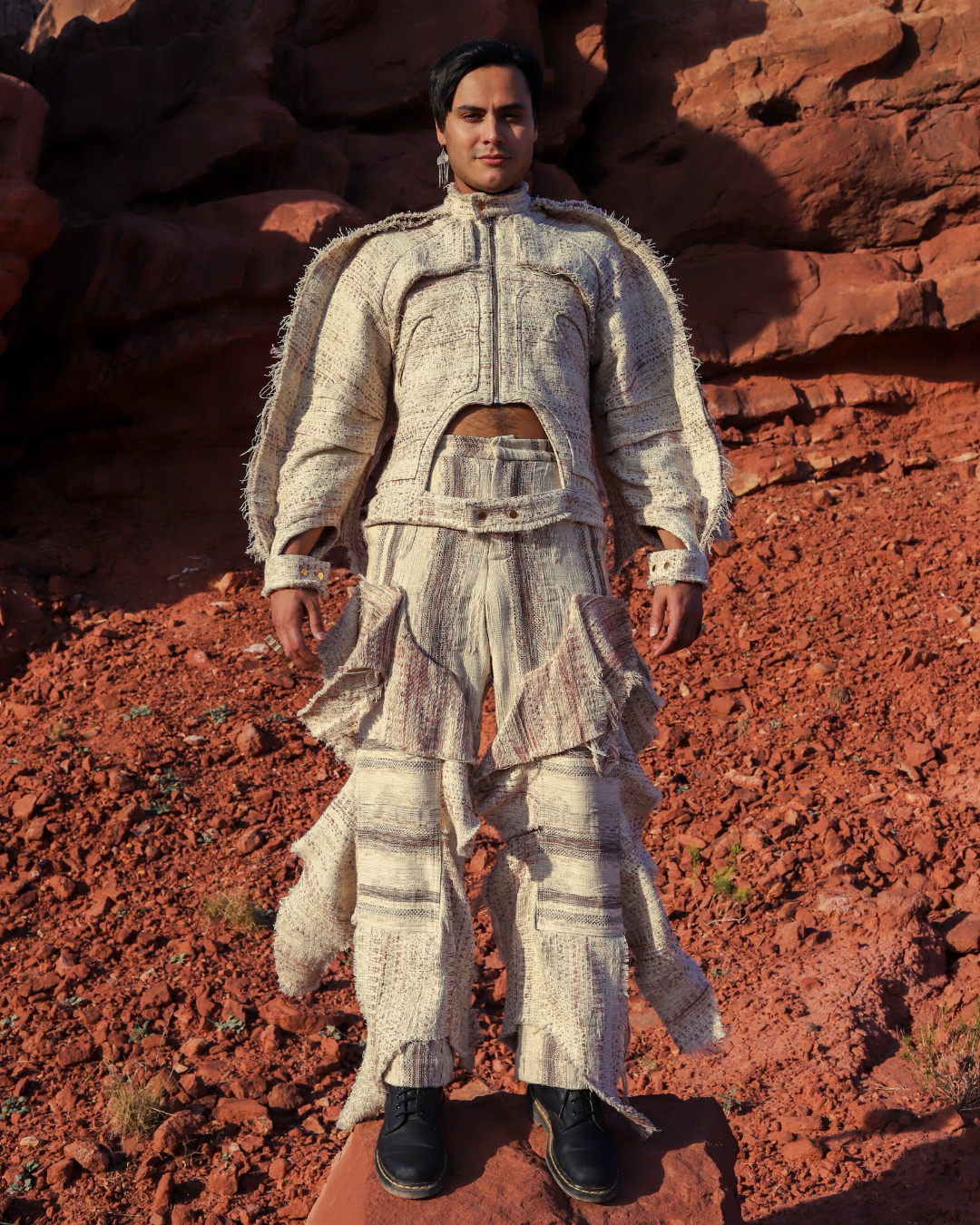
Today, Gordon’s wardrobe is a curated collection that champions Indigenous designers and celebrates bold individuality. Among his standout pieces are showstopping woven tweed suits crafted by Josh Tafoya, a Spanish/Genizaro/Chicano designer whose imaginative, Southwest-imbued creations recently earned him the prestigious Cooper Hewitt National Design Award. Tafoya’s work, characterized by its intricate textures and vibrant cultural narratives, perfectly aligns with Gordon’s desire for clothing that tells a story. Furthermore, during the wrapping of Dark Winds Season 5, Gordon may have "snagged some of Chee’s custom-made ‘70s styles," integrating elements of his character’s distinctive look into his personal wardrobe, blurring the lines between his professional and personal aesthetic. On the red carpet, he has frequently sported colorful custom suits from Running Horse Studio, featuring the signature hand-blocked prints of Chickasaw multidisciplinary artist Jimmy Dean Horn. Horn’s art, known for its dynamic patterns and cultural motifs, adds another layer of Indigenous artistic collaboration to Gordon’s public persona.

By consciously choosing to wear and promote the work of Indigenous designers, Gordon makes a powerful statement. He not only showcases exceptional talent within Native American communities but also contributes to a broader movement of Indigenous artists gaining mainstream recognition. This deliberate choice transcends mere fashion; it is an act of cultural affirmation, providing visibility and economic support to creators who might otherwise be overlooked by traditional fashion gatekeepers. His style, therefore, is not just about clothing; it’s a dynamic, living canvas that expresses his identity, his heritage, and his commitment to supporting a vibrant and diverse artistic community. This evolution in his personal style mirrors his growth as an actor and as an individual who is increasingly comfortable and confident in his own skin, embracing authenticity as his ultimate fashion statement.
The Creative Wellspring: Childhood Roots and Future Aspirations
Kiowa Gordon’s journey into the arts began in a household rich with siblings but, by his own account, creatively constrained. Growing up Mormon with seven brothers and sisters, Gordon found himself gravitating toward artistic pursuits rather than the sports favored by his older brothers. This early inclination blossomed into a collaborative creative outlet with his siblings, Mac, Cheyenne, and Lakota. Feeling "creatively suppressed as kids," they channeled their imaginative angst into homemade movies, meticulously filmed on the family camcorder. "We decided we were going to take back our imaginations and see what we could kick around," he recalls. "I loved going outside with my siblings and playing make-believe. Then I just never stopped loving movies and watching actors portray the beauty of the human condition." This childhood foundation instilled in him a profound appreciation for storytelling and the transformative power of performance, an appreciation that continues to drive his career.
Beyond acting, Gordon’s artistic curiosity spans various disciplines. Before dedicating his focus entirely to acting, he was the frontman for a metal band called Touché, demonstrating an early passion for music. Now, with the newfound stability afforded by Dark Winds, he is eager to reignite these dormant artistic loves. He speaks of returning to freehand drawing, painting, and making music, pursuits that connect him directly to his uninhibited childhood creativity. Moreover, Gordon is actively exploring new facets of the entertainment industry, trying his hand at producing and directing. This expansion of his professional scope reflects a desire for greater creative control and a deeper engagement with the storytelling process from behind the camera.

In these various endeavors, Gordon carries forward a fundamental artistic philosophy: a deep trust in the creative process and respect for fellow artists. "I’m not one to tell another artist how to let their creativity flow," he states. "As artists, we have this understanding that it’s our job to just let the truth in our hearts come out. So whether we bleed our hearts onto a canvas or a TV screen, it’s all coming from the same place." This ethos extends to his family life, particularly his relationship with his 13-year-old daughter, Kaili, an aspiring artist herself. Gordon takes care not to stifle her burgeoning creativity, fostering an environment where her artistic expression can flourish freely. This commitment to nurturing creativity, both in himself and in others, underscores his holistic approach to life and art, reflecting a hard-won sense of homeostasis that balances ambition with authenticity and personal well-being.
Redefining Success and Broader Implications for Indigenous Arts
The financial and professional security that Dark Winds has brought to Kiowa Gordon’s life marks a significant personal achievement and holds broader implications for the Indigenous arts community. His candid reflections on moving past a "survival mode" mentality highlight a common struggle for many artists, particularly those from underrepresented communities who often face systemic barriers to stable employment and recognition. This newfound freedom from constant financial anxiety allows Gordon to not only take better care of himself and his immediate family but also to more fully explore his creative passions, unburdened by the relentless pressure to secure the next paycheck.
"I still have that work ethic that was instilled in me from not having anything," Gordon affirms, demonstrating that his drive remains undiminished. "I’m still hungry, and I’m still going to fight. But it’s nice to finally take care of myself so I can in turn take care of my daughter, my family, and my friends. I feel like I can breathe easy and find my true self again." This sentiment underscores a powerful shift: from a career driven by necessity to one fueled by passion and purpose. For many Indigenous artists, such stability is a distant dream, often necessitating compromises that can dilute artistic integrity or force them away from their creative callings. Gordon’s experience serves as a beacon of hope, illustrating that sustained success and financial security are attainable within the mainstream entertainment industry without sacrificing one’s identity or heritage.

The success of Dark Winds and Gordon’s rising profile contribute significantly to the ongoing movement for greater Indigenous representation in media. Historically, Native American actors and stories have been largely marginalized, misrepresented, or entirely absent from Hollywood. According to recent studies, Indigenous peoples remain among the most underrepresented groups in film and television, both in front of and behind the camera. Dark Winds, with its authentic storytelling and commitment to Indigenous talent, actively works to dismantle these long-standing disparities. Its critical acclaim and commercial viability demonstrate unequivocally that Indigenous narratives resonate with a broad audience and are deserving of significant investment.
Moreover, Gordon’s conscious choice to champion Indigenous designers on red carpets and in interviews sends a clear message about the richness and diversity of contemporary Indigenous art and fashion. This act of advocacy not only provides vital exposure for these artists but also educates the public, challenging preconceived notions and celebrating a vibrant cultural landscape. His personal and professional journey, marked by authenticity, resilience, and a deep connection to his heritage, positions Kiowa Gordon not just as an actor, but as a cultural ambassador and a powerful voice for change within the entertainment industry. His ability to "breathe easy and find my true self again" and, consequently, "wear whatever the hell he feels like," symbolizes a larger victory for self-determination and cultural pride in a world increasingly hungry for genuine representation.