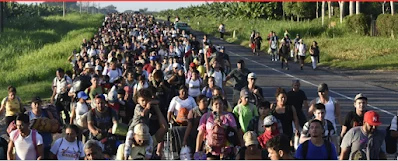
Hundreds of migrants, representing at least a dozen different nationalities, commenced a perilous journey on foot from Mexico’s southern border on a recent Sunday, embarking on a northbound trek with the ultimate aim of reaching the United States. This latest mass movement highlights the complex interplay of humanitarian crises, evolving immigration policies, and geopolitical anxieties, particularly the looming U.S. presidential election. The departure underscores a deepening sense of urgency among those seeking asylum, driven by fears that a change in U.S. leadership could drastically alter their prospects for legal entry.
The immediate catalyst for this determined march appears to be the approaching U.S. elections in November. Many participants openly expressed apprehension regarding the potential re-election of former President Donald Trump. Their primary concern centers on Trump’s repeated pledges to implement stringent border controls, including a potential complete closure of the border to asylum-seekers. This sentiment was articulated by Miguel Salazar, a migrant from El Salvador, who stated, "We are running the risk that permits [to cross the border] might be blocked." Salazar and others specifically fear that a new Trump administration could discontinue the use of the CBP One mobile application, a crucial digital portal currently utilized by asylum-seekers to secure appointments at U.S. border posts, enabling them to present their cases legally to immigration officials. The possibility of losing this avenue for legal entry has ignited a desperate race against time for many.
The Phenomenon of Migrant Caravans: A Historical Perspective
The formation of large migrant groups, often referred to as "caravans," is not a new phenomenon but has become a more prominent feature of migration patterns through Mexico in recent years. These organized movements first gained significant international attention around 2018, primarily as a response to the profound dangers migrants face when traveling individually or in small groups. The collective journey offers a measure of safety against predation by criminal gangs, who frequently target vulnerable migrants for extortion, kidnapping, and human trafficking. Furthermore, traveling in a large, visible group can sometimes deter arbitrary detention or expedited deportation by Mexican immigration authorities, who are often overwhelmed by the scale of these movements.
Historically, these caravans have served as both a strategic response to perilous transit conditions and a powerful symbol of mass displacement. While they offer a degree of collective security and draw media attention to the plight of migrants, they also present immense logistical and humanitarian challenges. The sheer scale of walking hundreds, sometimes thousands, of miles through varied and often harsh terrain takes a severe toll on participants. Exhaustion, lack of adequate food and water, exposure to elements, and prevalent health issues frequently lead to the fragmentation of these groups in southern Mexico, as individuals and smaller family units peel off to seek alternative, often more costly and dangerous, modes of transport or to rest.
Mexico’s Evolving Role in Migration Control
Mexico’s position as a critical transit country has placed it under significant pressure from the United States to manage irregular migration flows. Over recent years, Mexico’s government has steadily intensified its efforts to deter migrants from reaching its northern border. This tightening of controls has manifested in various ways, including increased deployment of National Guard troops to patrol migration routes, more frequent checkpoints, and a general hardening of policies aimed at restricting migrant movement.
Crucially, Mexico has recently implemented measures that make it considerably more difficult for migrants to utilize traditional public transportation methods, such as buses and trains, to travel northward. This policy shift forces more migrants onto perilous routes, often on foot through remote and dangerous territories, or into the hands of smugglers. This increased enforcement is often seen as a direct consequence of diplomatic pressure from the U.S., which has historically leveraged economic and trade relations to influence Mexico’s immigration policies. For instance, during previous administrations, threats of tariffs were used to compel Mexico to take a more active role in curbing northward migration.
Understanding the CBP One Application System
The CBP One mobile application, introduced by the U.S. Customs and Border Protection (CBP), represents a significant shift in how asylum-seekers are processed at the U.S. southern border. Launched as part of the Biden administration’s strategy to manage border arrivals more orderly, the app allows migrants to schedule appointments at official ports of entry to present their asylum claims. The system was designed to reduce irregular crossings between ports of entry, offering a regulated pathway for those seeking protection.
While intended to streamline the process and offer a safer alternative to illegal crossings, CBP One has faced considerable criticism. Many migrants report significant difficulties in securing appointments due to high demand, technical glitches, and inequities in access to smartphones and reliable internet. Wait times can extend for months, forcing vulnerable individuals to remain in precarious conditions in Mexican border towns. Human rights organizations have also raised concerns that the system, despite its intentions, inadvertently creates a digital barrier to asylum for those without the necessary resources or technological literacy, effectively limiting access to a legal right. The prospect of a future administration discontinuing this system entirely creates profound uncertainty and anxiety among those who view it as their only hope.
Roots of Migration: Push Factors in Home Countries
The desperation driving these migrants stems from deep-seated socio-economic and political crises in their home countries. While the "dozen countries" cited in the recent caravan reflect a diverse origin, a significant proportion typically originate from the Northern Triangle countries of Central America (Guatemala, Honduras, El Salvador), as well as Venezuela, Haiti, Cuba, and increasingly, countries outside the Western Hemisphere.
Economic hardship is a pervasive push factor. Many of these nations grapple with high unemployment rates, pervasive poverty, and limited economic opportunities. For instance, Honduras and Guatemala consistently rank among the poorest countries in Latin America, with large segments of their populations living below the poverty line. Political instability and corruption further exacerbate these conditions, eroding public trust and hindering effective governance.
Violence, particularly from powerful criminal gangs like MS-13 and Barrio 18, is another primary driver. These gangs exert control over vast territories, extorting businesses and individuals, and recruiting youth, often with brutal force. State institutions are frequently unable to provide adequate protection, leaving citizens with little recourse. Environmental disasters, intensified by climate change, also play a growing role. Droughts, hurricanes, and floods regularly devastate agricultural livelihoods and displace communities, forcing people to seek new homes and opportunities elsewhere. These compounding factors create an environment where staying put becomes more dangerous or impossible than undertaking a perilous journey.
U.S. Immigration Policy Landscape: A Historical Overview
The U.S. southern border has been a focal point of intense political and policy debate for decades, with various administrations attempting different approaches to manage migration.
During the Trump Administration (2017-2021): Policies were largely characterized by a focus on deterrence and enforcement. Key initiatives included:

- "Zero Tolerance" policy: Led to family separations at the border, drawing widespread condemnation.
- "Remain in Mexico" policy (Migrant Protection Protocols – MPP): Required asylum-seekers to wait in Mexico for their U.S. court dates, exposing them to significant dangers.
- Border wall construction: A signature promise aimed at physically impeding crossings.
- Title 42: Implemented during the COVID-19 pandemic, allowing for rapid expulsion of migrants without asylum screenings on public health grounds.
Under the Biden Administration (2021-Present): Initially, there was an effort to reverse some Trump-era policies, but the administration has also faced immense pressure to control border flows, leading to a complex mix of approaches:
- Ending "Remain in Mexico": Though its full termination faced legal challenges.
- Continued use of Title 42: For much of the administration, until its eventual lifting in May 2023.
- Introduction of CBP One: As a tool for orderly processing.
- Humanitarian Parole Programs: Creating specific pathways for certain nationalities (e.g., Venezuelans, Cubans, Haitians, Nicaraguans) to enter the U.S. legally, often tied to a sponsor.
- Increased enforcement: While seeking to expand legal pathways, the administration has also increased deportations and utilized expedited removal processes for those not using official channels.
This evolving policy landscape, marked by shifts and continuities, contributes to the uncertainty that fuels migrant movements, as individuals attempt to navigate a constantly changing regulatory environment.
Statistical Context: The Scale of Border Encounters
The scale of migration to the U.S. southern border has reached historic levels in recent years, placing immense strain on resources and systems. Data from U.S. Customs and Border Protection (CBP) consistently show elevated numbers of encounters. For instance, fiscal year 2023 recorded over 2.4 million encounters at the southwest border, following similarly high figures in previous years. This represents a significant increase compared to historical averages, indicating a sustained and complex migration phenomenon.
The demographics of those encountered have also shifted. While Central Americans traditionally constituted the largest group, recent years have seen a dramatic rise in migrants from Venezuela, Cuba, Nicaragua, and Haiti, as well as an increasing number of individuals from countries further afield, including China, India, and various African nations. This diversification reflects the global nature of displacement and the interconnectedness of international crises. Asylum claims have also surged, with hundreds of thousands of individuals seeking protection annually, far exceeding the capacity of existing processing systems. The CBP One app, while processing thousands of appointments monthly, only addresses a fraction of the overall demand, contributing to bottlenecks and frustration.
Voices from the Journey: Migrant Perspectives
The collective decision to join a caravan, despite its arduous nature, speaks volumes about the desperation and resilience of those involved. Beyond Miguel Salazar’s direct quote about the fear of blocked permits, the sentiments among migrants often revolve around a complex interplay of hope, fear, and determination. Many have undertaken previous, unsuccessful attempts to reach the U.S. or have spent months, if not years, in precarious conditions in Mexico, waiting for an opportunity.
For families with children, the journey is particularly harrowing. Parents speak of seeking a better future for their offspring, driven by the desire to escape violence, provide education, and ensure basic safety. The risks of the road – illness, injury, exploitation by cartels, and the constant threat of deportation – are weighed against the perceived inevitability of suffering if they remain in their home countries. The solidarity within the caravan, though often temporary, provides a vital psychological boost, fostering a sense of shared purpose and mutual support in the face of overwhelming odds.
Official Responses and International Cooperation
The latest migrant caravan will undoubtedly draw immediate attention from both U.S. and Mexican authorities. The U.S. government consistently reiterates its commitment to border security while also emphasizing the availability of legal pathways for those seeking asylum, such as the CBP One app and humanitarian parole programs. However, officials also stress that irregular crossings remain illegal and will be met with enforcement actions, including expedited removal. The Biden administration has repeatedly called for a comprehensive approach to border management, involving collaboration with regional partners to address the root causes of migration and to manage transit flows more effectively.
Mexico, for its part, finds itself in a challenging position. While it has historical ties to Central America and often provides humanitarian assistance to migrants, it is also increasingly pressured to act as a barrier to the U.S. border. Mexican officials often highlight their efforts to regularize migrants within Mexico and to provide humanitarian aid, while simultaneously implementing stricter enforcement measures. International organizations, such as the United Nations High Commissioner for Refugees (UNHCR) and the International Organization for Migration (IOM), play a crucial role in providing assistance, monitoring human rights, and advocating for humane migration policies in both Mexico and the U.S., often calling for greater regional cooperation and responsibility-sharing.
Humanitarian Concerns and Advocacy
The ongoing migration flows, particularly the formation of large caravans, raise significant humanitarian concerns. Migrants traveling on foot for extended periods are highly vulnerable to dehydration, exhaustion, illness, and injury. Women and children are especially susceptible to exploitation, including sexual violence and human trafficking. The lack of adequate shelter, sanitation, and medical care along the routes exacerbates these risks.
Humanitarian aid organizations and non-governmental organizations (NGOs) operating along the migration corridors in Mexico play a critical role, providing essential services such as food, water, medical attention, and legal counsel. These groups frequently advocate for stronger protections for asylum-seekers, lamenting policies that push migrants into more dangerous situations or restrict access to legal avenues for protection. They consistently call for an approach that prioritizes human dignity, due process, and the right to seek asylum, urging governments to address the systemic issues rather than simply focusing on enforcement.
Broader Implications: Regional Stability and Political Discourse
The continuous flow of migrants, underscored by events like the recent caravan, has profound implications for regional stability and fuels heated political discourse, particularly in the United States. In the U.S., border security and immigration policy remain a top-tier issue, heavily influencing electoral campaigns and public opinion. The perception of an "open border" or "uncontrolled migration" is often weaponized in political rhetoric, creating divisions and making bipartisan solutions exceedingly difficult to achieve. The upcoming presidential election has amplified these debates, with candidates presenting starkly different visions for border management and immigration reform.
For Mexico and other transit countries, the implications are also significant. Managing the transit of hundreds of thousands of migrants strains national resources, infrastructure, and social services. It also impacts diplomatic relations with the U.S., often placing Mexico in the difficult position of balancing its own sovereignty with the demands of its powerful northern neighbor. The humanitarian crises unfolding along these routes challenge the ethical frameworks of governments and international bodies, calling into question the effectiveness and humanity of current policies.
Looking Ahead: The Uncertain Future of Asylum
The immediate future for the migrants currently walking through southern Mexico, and for countless others contemplating similar journeys, remains highly uncertain. The outcome of the U.S. presidential election in November will undoubtedly cast a long shadow over U.S. immigration policy. A potential return to more restrictive policies, as feared by many migrants, could lead to a dramatic reduction in asylum access, a renewed emphasis on deterrence, and potentially an increase in irregular crossings as legal pathways become further constrained. Conversely, even if current policies persist, the underlying push factors driving migration show no signs of abating, ensuring that the challenges at the border will continue.
Effectively managing cross-border migration requires a multifaceted approach that addresses the root causes of displacement, fosters regional cooperation, ensures humane treatment and due process for asylum-seekers, and develops efficient and equitable systems for legal entry. Until such a comprehensive framework is consistently implemented, the spectacle of large migrant groups embarking on perilous journeys, driven by desperation and hope, is likely to remain a recurring and poignant feature of the evolving migration landscape.