

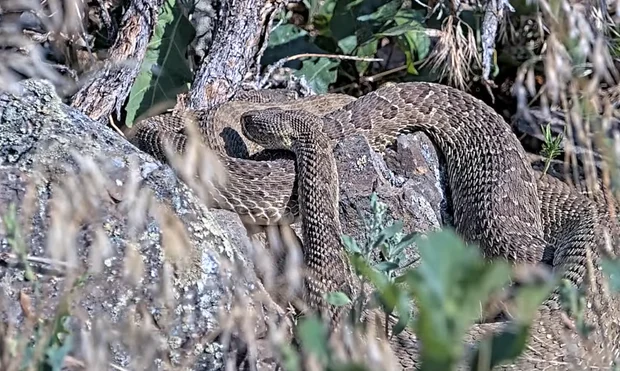
A groundbreaking initiative by Cal Poly has launched a YouTube livestream offering a rare and captivating window into the bustling activity of a rattlesnake "mega-den" located on private property in Northern Colorado. This innovative project, part of the broader RattleCam.org community science endeavor, provides both researchers and the public with an unparalleled opportunity to observe the intricate behaviors of wild rattlesnakes, particularly focusing on the dynamics of pregnant females and the eventual arrival of their young later this summer. The exact location of the den remains undisclosed to protect the snakes and their habitat from potential disturbance, a critical ethical consideration for the project.
Unveiling the "Mega-Den": A Hub of Herpetological Activity
The chosen den site in Northern Colorado is a natural geological marvel, featuring an intricate network of rock formations and subterranean chambers that provide ideal conditions for hundreds of rattlesnakes to congregate. Researchers have designated it a "mega-den" due to the sheer volume of snakes it attracts annually, a phenomenon driven by the need for secure overwintering sites and suitable birthing grounds. Observations from the live cam, which became widely accessible this week, have already showcased a dynamic scene: numerous rattlesnakes, identifiable primarily as Prairie Rattlesnakes (Crotalus viridis), are seen moving deliberately, basking in the sun, and often intertwining or resting atop one another. This dense aggregation is characteristic of communal denning, a crucial survival strategy for these ectothermic reptiles.
The livestream’s primary scientific objective revolves around understanding the reproductive ecology and social interactions of rattlesnakes. By closely monitoring pregnant females, researchers aim to gather data on gestation periods, den fidelity, communal birthing practices, and the subsequent maternal care of neonates. Rattlesnakes, unlike many other snake species, are viviparous, meaning they give birth to live young. This makes the observation of maternal behavior particularly significant, as it offers insights into a less-understood aspect of their biology. The project seeks to answer fundamental questions about how these animals choose birthing sites, how they interact with other snakes during this vulnerable period, and the extent of parental investment in their offspring.
The Annual Cycle: Rattlesnakes in the Colorado Ecosystem
To fully appreciate the significance of the RattleCam project, it is essential to understand the annual life cycle and ecological role of rattlesnakes in Colorado. The state is home to several species of rattlesnakes, with the Prairie Rattlesnake being the most common and widespread, particularly across the eastern plains and lower elevations of the western slope, including Northern Colorado. These snakes emerge from hibernation typically in late April or May, once ambient temperatures consistently rise above a critical threshold, usually around 60°F (15°C). Their emergence is often staggered, with males and non-gravid females appearing first, followed by pregnant females who require warmer conditions for gestation.
Upon emergence, rattlesnakes disperse from their dens to hunt for prey, primarily rodents, birds, and sometimes other reptiles. Mating usually occurs in late spring or early summer. Following successful mating, pregnant females seek out suitable gestation sites, often returning to communal dens or specific rock crevices that offer stable temperatures and protection. Gestation typically lasts 2-3 months, and the young are born live, encased in a thin membrane from which they quickly emerge. A typical litter can range from 4 to 25 young, though average litter sizes for Prairie Rattlesnakes are often between 8 and 12. These neonates are born with fully functional fangs and venom and are immediately independent, though they often remain near the birthing den for a period before dispersing. As autumn approaches and temperatures drop, rattlesnakes begin to return to their communal dens, sometimes traveling several miles, to brumate (the reptilian equivalent of hibernation) through the winter months, a cycle that repeats annually. The "mega-den" observed by RattleCam is precisely one of these crucial overwintering and birthing sites.
Advancing Herpetological Research Through Citizen Science
The RattleCam.org project is not merely a passive viewing experience; it is explicitly designed as a community science initiative. This means that public engagement is a core component, encouraging viewers to contribute to data collection and analysis. While specific instructions for citizen scientists might be detailed on the RattleCam website, typical contributions could involve logging snake counts, identifying specific behaviors (e.g., basking, moving, interacting with others), or noting the appearance of new individuals or offspring. This crowdsourced data can significantly augment the observational capacity of lead researchers, allowing for a much larger dataset than a small team could collect independently.

From the perspective of Cal Poly researchers, the "mega-den" offers an unprecedented natural laboratory. Traditional field research on rattlesnakes often involves trapping, tagging, and radio-telemetry, which can be invasive and labor-intensive. While these methods provide crucial data on movement and habitat use, a non-invasive livestream allows for continuous, long-term observation of natural behaviors without disturbing the animals. The sheer density of snakes in this particular den provides a unique opportunity to study social dynamics within a large population, something that is difficult to replicate in smaller or more dispersed groups. Researchers hope to gain insights into population structure, individual recognition (if distinct markings or patterns can be identified), and the potential for communal defense or thermoregulation within the den.
Expert Perspectives and Ethical Considerations
While Cal Poly is leading the research, the project undoubtedly benefits from, and contributes to, the broader understanding of wildlife management in Colorado. Wildlife experts, such as those from Colorado Parks and Wildlife (CPW), frequently emphasize the importance of public education regarding native species. Though no direct statements from CPW were provided in the original content, it is highly probable that they would view such a project positively. "Initiatives like RattleCam are invaluable," a hypothetical CPW spokesperson might comment, "as they demystify often-misunderstood creatures like rattlesnakes. By allowing the public to observe them in their natural habitat, we foster a greater appreciation for wildlife and promote responsible coexistence."
Ethical considerations are paramount in any wildlife research, especially involving potentially sensitive species. The decision to keep the den’s exact location private is a testament to this commitment. Publicizing such a site could lead to unauthorized visits, harassment of the snakes, or even illegal collection, which would undermine both the research and conservation efforts. The non-invasive nature of the livestream ensures that the snakes’ natural behaviors are observed without human interference, maintaining the integrity of the data. Researchers are likely adhering to strict protocols to minimize their own physical presence at the site, relying primarily on the remote camera system.
Broader Impact: Education, Conservation, and Coexistence
The RattleCam project has far-reaching implications beyond pure scientific discovery.
- Public Education: For many people, snakes evoke fear or apprehension. The livestream serves as a powerful educational tool, allowing viewers to observe rattlesnakes not as menacing creatures, but as fascinating components of the ecosystem. Watching them interact, bask, and eventually care for their young can help dispel myths, reduce ophidiophobia, and cultivate a sense of wonder and respect for these reptiles. It offers a chance to see their natural behaviors, highlighting their role as predators that help control rodent populations, which benefits agricultural areas and reduces disease vectors.
- Conservation Awareness: While Prairie Rattlesnakes are not currently listed as endangered, their habitats are continuously threatened by urban sprawl, agricultural expansion, and human encroachment. Understanding their denning requirements, reproductive success, and population dynamics is crucial for developing effective conservation strategies. The project can raise awareness about habitat preservation and the importance of protecting key denning sites. By observing the health and activity of this "mega-den," researchers can gain insights into the overall health of regional rattlesnake populations.
- Promoting Coexistence: As human populations expand into natural habitats, encounters with wildlife, including rattlesnakes, become more frequent. The RattleCam can indirectly contribute to public safety by fostering a more informed populace. Viewers who understand rattlesnake behavior are better equipped to react appropriately if they encounter one in the wild – typically by giving it space and moving away. It reinforces the message that rattlesnakes are generally not aggressive but will defend themselves if threatened.
- Technological Innovation in Research: The successful deployment and ongoing operation of RattleCam also highlight the increasing role of remote sensing and digital platforms in ecological research. Live-streaming technology offers a cost-effective and continuous monitoring solution that can be applied to various species and ecosystems, opening new avenues for long-term ecological studies and citizen science participation globally.
The Future of RattleCam: Awaiting New Life
As the summer progresses, anticipation will build around the RattleCam.org livestream for the moment when the pregnant females begin to give birth. This period, expected later in the summer, will be a critical phase for the research, offering unique insights into neonate development, early social interactions among the young, and the extent of maternal protection. The project plans to continue monitoring the den through the autumn as the snakes prepare for brumation, providing a complete annual cycle of observation.
The Cal Poly RattleCam stands as a testament to how technology, scientific curiosity, and community engagement can converge to shed light on the hidden lives of wildlife. It offers a unique opportunity for people worldwide to connect with nature, learn about the vital role of often-feared creatures, and contribute directly to scientific understanding, all from the comfort of their homes. This live window into the world of Colorado’s rattlesnakes promises to be a continuous source of fascination and valuable data for months to come.









