

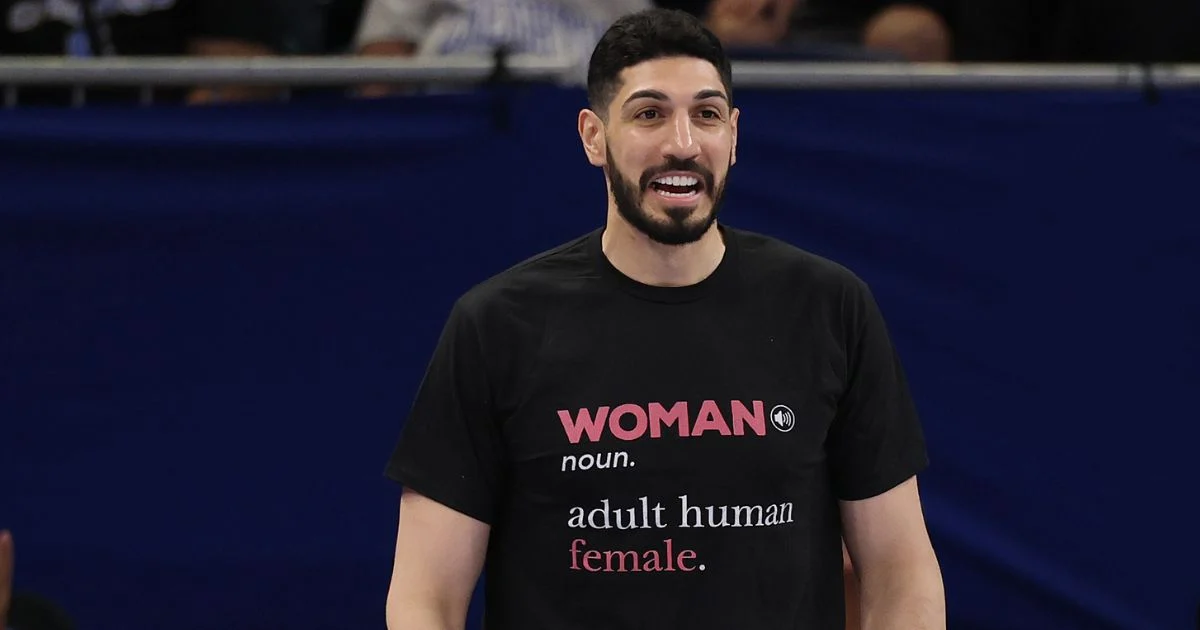
Former NBA player Enes Kanter Freedom announced Wednesday that he has formally engaged with the Federal Bureau of Investigation (FBI) following a deluge of death threats directed at him. These threats emerged after he publicly stated his intention to attend Game 3 of the WNBA Finals in Atlanta, Georgia. The alarming messages, including one explicitly warning he would be "the next Charlie Kirk," prompted a swift response from Freedom and the involvement of both federal and state authorities, underscoring the escalating tensions at the intersection of sports, activism, and public discourse.
Despite the grave nature of the threats, Freedom affirmed his resolute commitment to attending the highly anticipated WNBA Finals game between the Atlanta Dream and the Golden State Valkyries. His decision to proceed, even under heightened security risks, highlights a broader narrative of an athlete-turned-activist confronting significant personal danger in pursuit of his convictions. The incident casts a spotlight on the challenges faced by public figures in navigating a contentious social and political landscape, where online rhetoric can rapidly escalate into credible threats of violence.
Escalation of Threats and Official Response
Freedom, a vocal advocate for human rights and an outspoken critic of various political ideologies, revealed that he had received "thousands of death threats" in the days leading up to the scheduled game. These threats, disseminated primarily through direct messages on social media platforms, included graphic imagery and explicit warnings of physical harm. One particularly disturbing message directly referenced conservative commentator Charlie Kirk, stating Freedom would be "the next Charlie Kirk." While Charlie Kirk, founder of Turning Point USA, has not been the victim of a shooting, the reference to violence associated with a prominent conservative figure in such threats is designed to intimidate and instill fear.
In response to the severity of these communications, Freedom confirmed that he and his team immediately contacted the FBI. "So we are in touch with [the] FBI. We have our own security," Freedom stated, emphasizing the multi-layered approach being taken to ensure his safety. This proactive measure by Freedom’s team aligns with standard protocols for public figures facing credible threats, where law enforcement agencies are brought in to assess the risk and implement protective measures.

Further illustrating the seriousness with which these threats are being treated, Freedom disclosed that the office of Georgia’s Republican Governor, Brian Kemp, had also offered assistance. "We have a conversation with the governor, and he’s providing us security as well," the former New York Knick declared. A spokesperson from Governor Kemp’s office subsequently confirmed to OutKick, a sports and culture media outlet, that "Our office connected their team with the appropriate law enforcement resources." This collaboration between state and federal agencies, alongside private security, paints a picture of comprehensive security planning for Freedom’s attendance at the WNBA Finals. He further elaborated, "There’s going to be a lot of FBI officers around the game, so, and they will be protecting us." This level of visible law enforcement presence at a major sporting event due to specific threats against an attendee is indicative of the perceived risk.
A Chronology of Provocation and Response
The current security concerns are not isolated but rather represent the latest chapter in Kanter Freedom’s increasingly contentious engagement with the WNBA and the broader discourse on gender in sports.
- August 2026: Freedom was ejected from a Chicago Sky game following a confrontation with one of the players. Details of the confrontation remain somewhat disputed, but the incident highlighted his readiness to engage directly within the WNBA environment.
- September 2026: Freedom publicly declared his intention to "declare for the WNBA draft," challenging the league’s eligibility rules and arguing that the WNBA "cannot define a woman." This move was widely interpreted as a political statement aimed at sparking debate on transgender participation in women’s sports and the definition of gender in athletic contexts.
- October 20, 2026 (Tuesday): As threats mounted, Freedom posted a defiant montage to social media platform X (formerly Twitter) that included some of the threatening messages. Tagging the WNBA in his post, he wrote: "What’s up, Atlanta? I heard y’all loud and clear. Let me remind y’all one thing, I fear God and God alone. See y’all tomorrow… @WNBA." This public display of courage, while also highlighting the threats, served to amplify his message and solidify his commitment to attending the game.
- October 21, 2026 (Wednesday): Freedom confirms FBI involvement and state security assistance, reiterating his plans to attend Game 3 of the WNBA Finals.
- Days Prior to October 21: WNBA Commissioner Cathy Engelbert sent a letter to Congressional lawmakers explicitly rejecting the eligibility of both Enes Kanter Freedom and former NBA player Royce White to join the league, unequivocally stating that the WNBA is "only for women." This official communication solidified the league’s position and directly countered Freedom’s previous public statements regarding his eligibility.
Enes Kanter Freedom: Activism Beyond the Court
Enes Kanter Freedom, a Turkish-American professional basketball player, became a naturalized U.S. citizen in 2021 and legally changed his name to Enes Kanter Freedom to honor his commitment to human rights. His journey into activism began years ago with his outspoken criticism of Turkish President Recep Tayyip Erdoğan and the Turkish government’s human rights record. This stance led to his passport being revoked by Turkey, his family disowning him under duress, and numerous threats from the Turkish regime, including an Interpol red notice. His experience as a political dissident has shaped his fearless approach to public discourse, even in the face of personal danger.
More recently, Freedom has turned his attention to issues within the United States, particularly focusing on what he perceives as a deviation from traditional American values and principles. His engagement with the WNBA falls squarely into this new phase of activism. His argument that the WNBA cannot adequately define "woman" and, therefore, cannot bar him from playing, is a direct challenge to contemporary discussions surrounding gender identity, biological sex, and fairness in women’s sports. He sees his presence at the WNBA Finals not as a mere spectator but as a continuation of his broader mission to advocate for what he believes are fundamental truths and protections for women athletes.

"Ever since I declared for the WNBA draft, the league has been completely silent and unable to explain their own rules," Freedom claimed last month. "The reason why the league has been silent is simple: the WNBA cannot define a woman, and their current rules do not prevent me from playing in the league." He added, "It’s time for the WNBA to explain themselves, and it’s time for the WNBA to ensure safety and fairness for all players and fans."
Despite the provocative nature of his prior statements, Freedom attempted to frame his attendance at the Finals as supportive. "I’m going there to enjoy the game," he stated. "I’m going there to support all these hardworking women, especially Gabby Williams and Angel Reese… We are not here to mock or make fun of anyone or any personal decision." He concluded by clarifying his intentions: "Many people think that I’m going there to troll. No, I’m going there to support women, protect women, and make sure that I enjoy the game." This dual narrative—challenging the league’s policies while professing support for its athletes—adds complexity to his public persona and the public’s perception of his motives.
Broader Implications: Athlete Safety, Free Speech, and Public Discourse
The incident involving Enes Kanter Freedom underscores several critical issues currently permeating public life, particularly at the intersection of sports, politics, and social media.
- Athlete Safety and Online Harassment: The "thousands of death threats" received by Freedom are a stark reminder of the increasing vulnerability of public figures, including athletes, to online harassment and credible threats of violence. In an era of heightened political polarization, social media platforms have become conduits for extreme rhetoric, often crossing the line from protected speech to incitement. Studies indicate a significant rise in online threats against public figures across various sectors, necessitating robust security measures and vigilant law enforcement responses. The fact that the FBI and state authorities are involved highlights the seriousness of such threats and the potential for real-world consequences.
- Freedom of Speech vs. Incitement: Freedom’s outspoken nature, while celebrated by some as courageous, is viewed by others as inflammatory. The threats he receives, however, represent a dangerous escalation that transcends mere disagreement. The challenge for authorities lies in distinguishing between offensive or controversial speech and actual incitement to violence, a distinction crucial for upholding both free speech principles and public safety.
- The Politicization of Sports: Once considered a unifying force, professional sports leagues, including the WNBA, have increasingly become arenas for political and social commentary. Athletes themselves are more vocal on social issues, and sporting events often draw attention from activists across the political spectrum. Freedom’s presence at the WNBA Finals, irrespective of his stated intentions, inherently carries political weight given his prior pronouncements on gender and the league’s explicit stance. This politicization can lead to heightened tensions, as evidenced by the security measures required for his attendance.
- The Debate on Gender Identity in Sports: Freedom’s persistent challenge to the WNBA’s definition of "woman" directly engages with one of the most contentious social debates of our time: the role of gender identity versus biological sex in competitive athletics. While the WNBA Commissioner has issued a clear statement on eligibility, the broader societal discussion continues, impacting policies at all levels of sport. Freedom’s actions bring this debate directly into the public consciousness through a high-profile sporting event.
- The Role of Law Enforcement in Protecting Public Figures: The swift involvement of the FBI and the Georgia Governor’s office demonstrates the critical role of law enforcement in protecting individuals, particularly those who are highly visible and often targets of intense public scrutiny. Their coordination and commitment to ensuring Freedom’s safety at the event are paramount, serving as a deterrent against potential aggression and reinforcing the principle that threats of violence are taken seriously, regardless of the target’s political leanings.
Conclusion
Enes Kanter Freedom’s determination to attend the WNBA Finals amid a torrent of death threats serves as a potent symbol of the complex interplay between personal conviction, public safety, and the contentious issues defining contemporary society. His engagement with federal and state law enforcement, coupled with private security, underscores the severity of the situation and the lengths taken to protect individuals in an increasingly polarized environment. As he takes his seat at the game, Freedom’s presence will undoubtedly be scrutinized, not just for his stated support of women athletes, but also as a testament to his unwavering commitment to his principles, even when confronted with grave personal danger. The incident stands as a stark reminder of the responsibilities that come with public platforms and the enduring challenges of maintaining civil discourse in an era of heightened tensions.









