

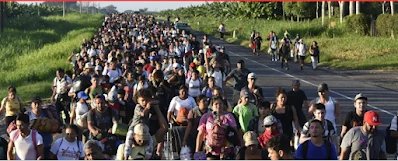
Hundreds of migrants, originating from approximately a dozen different countries, embarked on a perilous journey from Mexico’s southern border on Sunday, setting out on foot with the ultimate aim of reaching the United States border. This latest movement underscores the persistent and complex challenges of irregular migration in the Americas, a phenomenon shaped by a confluence of socio-economic pressures, political instability in home countries, and evolving immigration policies in transit and destination nations. The immediate impetus for this particular group’s accelerated departure appears deeply rooted in the political calendar of the United States, with many expressing profound anxieties about the upcoming November presidential elections and the potential policy shifts that could follow.
The Journey Begins: A Desperate Exodus
The group, diverse in its composition, includes individuals and families from Central and South America, as well as countries further afield, all united by a common hope for safety and opportunity. Their journey began in the southern Mexican state of Chiapas, a region that has long served as a primary gateway for migrants traversing Mexico. The decision to undertake such a demanding trek, often hundreds or thousands of miles, highlights the extreme circumstances compelling these individuals to leave their homes. Testimonies from within the group reveal a pervasive fear that the window for seeking asylum in the U.S. might soon close.
Miguel Salazar, a migrant from El Salvador, articulated a sentiment widely shared among his fellow travelers. "We are running the risk that permits [to cross the border] might be blocked," Salazar stated, conveying a tangible apprehension about the potential re-election of former U.S. President Donald Trump. His specific concern, echoed by many, is that a new Trump administration could cease granting appointments through CBP One, a mobile application currently utilized by asylum-seekers to schedule appointments at U.S. border posts, allowing them to present their cases to immigration officials legally. This digital pathway, while imperfect and often overwhelmed, represents one of the few formal avenues available for asylum claims at the border. The perceived fragility of this system, coupled with the uncertainty of the U.S. political landscape, has spurred many to accelerate their attempts to reach U.S. territory.
The Shadow of U.S. Elections
The U.S. presidential election, scheduled for November, casts a long shadow over migration patterns across the hemisphere. Donald Trump, the presumptive Republican nominee, has consistently advocated for stricter border enforcement and has made promises to implement more restrictive immigration policies if re-elected. During his previous term, his administration pursued a range of measures, including the "Remain in Mexico" policy (Migrant Protection Protocols) and the use of Title 42 public health authority to rapidly expel migrants. His campaign rhetoric frequently emphasizes securing the border, deporting undocumented immigrants, and ending what he refers to as "catch and release."
These past actions and current pledges resonate deeply among migrant communities, particularly the vow to "close the border" to asylum-seekers. While international and U.S. law dictates that individuals have the right to seek asylum, the practical implementation of this right has been subject to various interpretations and policy changes. The fear among migrants is not merely of increased enforcement, but of a fundamental curtailment of their ability to even initiate an asylum claim, effectively shutting down the legal and quasi-legal pathways currently available. This apprehension acts as a powerful "pull" factor, paradoxically encouraging a faster, more desperate movement towards the border before a potential policy shift takes effect.
The Role of CBP One
The CBP One application, launched in January 2023, was designed by the Biden administration as a mechanism to manage border crossings more orderly and reduce irregular crossings between ports of entry. It allows migrants in central and northern Mexico to pre-register and schedule appointments to present themselves at designated ports of entry, rather than attempting dangerous unauthorized crossings. While it has facilitated tens of thousands of appointments – with U.S. Customs and Border Protection reporting that as of early 2024, over 450,000 individuals had successfully scheduled appointments via CBP One since its inception – it has also been criticized for its technical glitches, limited availability of slots, and the inherent difficulties many vulnerable migrants face in accessing and using the technology. The fear that a future administration might dismantle or severely restrict access to CBP One is a significant motivator for those currently en route.
A Historical Perspective: The Evolving Phenomenon of Migrant Caravans
The concept of large groups of migrants traveling together, often referred to as "caravans," is not new, though it gained significant international attention starting in the mid-2010s. These organized movements typically originate in Central America or Mexico’s southern states. Historically, migrants attempting to pass through Mexico have organized into these larger groups for strategic reasons. The primary motivations include enhanced safety and solidarity. Traveling in large numbers offers a degree of protection against the rampant dangers faced along the migratory route, including attacks by criminal gangs, kidnappings, extortion, and human trafficking. Mexican criminal organizations frequently target vulnerable migrants, and a large, visible group can sometimes deter these threats.
Additionally, larger groups often hope to gain greater visibility and, consequently, a measure of protection from Mexican immigration authorities. While Mexican officials have a mandate to enforce immigration laws, the sheer size and humanitarian implications of a large caravan can sometimes lead to a more cautious approach, at least initially, from enforcement agencies. However, the experience of past caravans demonstrates a consistent pattern: while they may start strong, these movements tend to fragment as they progress northward. The arduous physical demands of walking hundreds of miles, coupled with exhaustion, lack of resources, and the challenges of maintaining group cohesion, often lead individuals and smaller families to break off from the main body, seeking alternative, often more fragmented, means of transportation or rest. This fragmentation leaves many vulnerable to the very dangers they sought to avoid by joining the caravan.
Mexico’s Shifting Stance on Transit
Mexico’s role in the regional migration dynamic is complex and has evolved significantly in recent years, often under pressure from the United States. Historically, Mexico has been both a country of origin and transit for migrants. However, increased U.S. pressure, particularly during the Trump administration, led Mexico to significantly step up its immigration enforcement efforts along its southern border and within its interior. This shift has included increased deployments of its National Guard, more frequent checkpoints, and greater efforts to interdict migrants traveling by various means.
Recently, Mexico has made it demonstrably more difficult for migrants to reach its northern border via conventional methods like buses and trains. Transportation companies face severe penalties if found transporting undocumented migrants, leading to a de facto ban on migrants purchasing tickets for long-distance travel. This policy effectively forces migrants into more clandestine and dangerous modes of transport, or, as observed with the current group, to travel primarily on foot. The crackdown on public transportation options has had a cascading effect, pushing migrants into the hands of smugglers (coyotes) who charge exorbitant fees for dangerous journeys, or forcing them into the physically demanding and risky option of walking long distances through remote and hostile terrain.
Deterrents and Diversions

The Mexican government’s intensified enforcement, often at the behest of the U.S., aims to deter migration and disperse large groups. While it may succeed in breaking up caravans and making the journey more arduous, it rarely stops the flow entirely. Instead, it often diverts migrants to more dangerous routes, exacerbating humanitarian concerns. This dynamic creates a challenging environment for both migrants and humanitarian organizations, as the journey becomes longer, more expensive, and fraught with greater risks of exploitation, injury, and death.
Statistical Context: The Broader Migration Landscape
The current movement of migrants occurs against a backdrop of historically high numbers of encounters at the U.S.-Mexico border. U.S. Customs and Border Protection (CBP) data consistently shows elevated figures. For instance, fiscal year 2023 saw over 2.4 million migrant encounters at the Southwest border, following similarly high numbers in fiscal year 2022. While these numbers represent encounters, not unique individuals (some migrants attempt to cross multiple times), they illustrate the immense pressure on border resources and the persistent flow of people.
The demographics of migrants have also diversified. While historically Central Americans (from the Northern Triangle countries of Honduras, El Salvador, and Guatemala) constituted the majority, recent years have seen a significant increase in migrants from South America (Venezuela, Ecuador, Colombia), the Caribbean (Cuba, Haiti), and even countries outside the Western Hemisphere, such as China and India. This diversification reflects broader global instability, economic crises, and political repression, pushing people from increasingly varied backgrounds to seek refuge and opportunity elsewhere. Venezuela, in particular, has seen millions flee due to a severe economic and political crisis, contributing significantly to regional migration flows.
Asylum claims, while a legal right, face substantial backlogs in the U.S. immigration system. Tens of thousands of asylum cases are pending, with processing times often stretching for years. This backlog, combined with the difficulty of accessing legal pathways at the border without an appointment, contributes to the desperation driving many migrants to attempt irregular crossings. CBP One, despite its stated purpose, can only accommodate a fraction of the daily demand for appointments, leaving many in limbo in Mexican border cities, vulnerable and often without resources.
Official Responses and Policy Frameworks
The U.S. government, under the Biden administration, has attempted to balance border enforcement with the creation of legal pathways for migration. This strategy includes expanding access to the CBP One app, increasing refugee processing, and implementing parole programs for certain nationalities, while simultaneously increasing resources for border patrol and expediting deportations for those deemed ineligible for asylum or other forms of relief. Officials routinely emphasize that irregular crossings are dangerous and that individuals should utilize legal pathways. However, critics from both sides of the political spectrum argue that these policies are either too lenient or too restrictive, failing to address the root causes of migration or adequately manage the border.
The Mexican government, while increasing enforcement, also faces significant humanitarian challenges. It provides some level of humanitarian assistance and temporary permits to migrants, particularly in southern states. However, its resources are often stretched thin, and its policies are frequently perceived as reactive to U.S. demands rather than proactive solutions to regional migration. Mexico’s foreign relations ministry often highlights its efforts to manage migratory flows humanely while also asserting its sovereign right to control its borders. Bilateral cooperation with the U.S. on migration issues remains a critical, albeit often contentious, aspect of their relationship.
International organizations and non-governmental organizations (NGOs) operating along the migration routes consistently raise alarms about the humanitarian crisis. Groups like Doctors Without Borders, UNHCR, and local advocacy organizations provide medical care, shelter, and legal aid to migrants. They frequently call for greater protection for asylum-seekers, expanded legal pathways, and a more humane approach to border management by both U.S. and Mexican authorities. They also highlight the severe mental and physical toll the journey takes on migrants, particularly children and vulnerable individuals.
Humanitarian Concerns and Risks on the Route
The journey from Mexico’s southern border to the U.S. is fraught with immense dangers, regardless of whether migrants travel in large groups or individually. The natural environment itself poses significant threats: extreme heat, lack of water, treacherous terrain, and dangerous wildlife. Migrants are susceptible to dehydration, heatstroke, exposure, and exhaustion. Beyond environmental hazards, the human element presents an even greater risk. Criminal organizations, including drug cartels and human trafficking networks, operate with impunity in many areas along the route. Migrants are vulnerable to extortion, kidnapping, sexual assault, and forced labor. The lack of legal status makes them easy targets, as they are often hesitant to report crimes to authorities for fear of deportation.
The psychological toll is also substantial. The constant threat of danger, separation from family members, and the uncertainty of their future can lead to severe trauma, anxiety, and depression. Children, in particular, are highly vulnerable to these stressors, often experiencing long-term psychological impacts. The humanitarian crisis is compounded by limited access to medical care, adequate food, and safe shelter along much of the route.
Broader Implications: Regional Stability and Future Policy
The ongoing movement of migrants, exemplified by the current group departing from Mexico’s southern border, has profound implications for regional stability and future policy. For U.S.-Mexico relations, migration remains a dominant and often strained issue. The U.S. relies on Mexico to manage its southern border and to accept repatriated migrants, while Mexico navigates its own sovereignty and humanitarian responsibilities. The outcome of the U.S. elections could significantly alter this dynamic, potentially leading to increased pressure on Mexico to further restrict transit or to absorb a larger number of asylum-seekers if U.S. policies become more restrictive.
Domestically in the U.S., immigration continues to be a highly politicized topic, central to the upcoming presidential campaign. The perceived "crisis at the border" fuels intense debate and division, impacting legislative efforts and public discourse. Any drastic policy shifts following the election, whether toward stricter enforcement or more expansive legal pathways, will have immediate and significant consequences for migrants, border communities, and the U.S. economy.
Ultimately, the phenomenon of irregular migration is a complex tapestry woven from global economic disparities, political instability, climate change, and human desperation. The current group of migrants, walking towards an uncertain future, represents a powerful testament to the enduring human drive for safety and a better life, even in the face of daunting odds and evolving, often restrictive, international policies. Addressing this challenge requires not only border management strategies but also comprehensive approaches that tackle root causes, expand legal and safe pathways, and uphold international humanitarian obligations. The journey of these hundreds of individuals highlights the urgent need for a more sustainable and humane regional migration framework.








