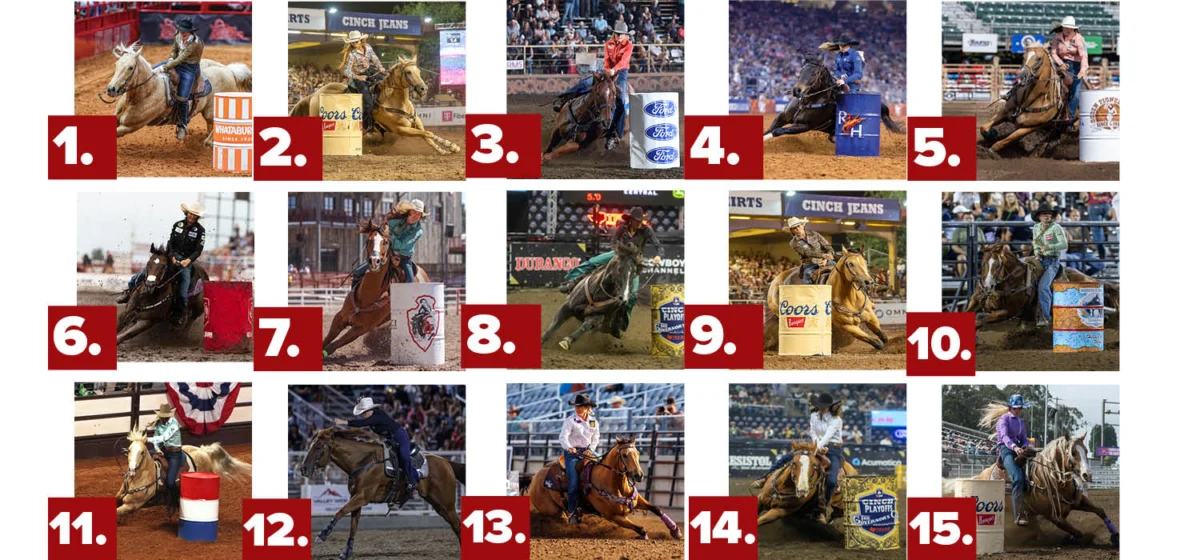
The rigorous 2025-2026 Women’s Professional Rodeo Association (WPRA) season, spanning from October 1, 2025, to September 30, 2026, culminated in the qualification of the Top 15 barrel racers for the prestigious National Finals Rodeo (NFR). This year, the journey to rodeo’s grandest stage underscored the unparalleled contribution of equine athletes, with 56 different horses collectively earning the necessary prize money to propel their riders into contention. An exclusive analysis by Barrel Horse News reveals the intricate web of talent, breeding, and unwavering partnership that defines success at the highest echelon of professional barrel racing.
The Road to the NFR: A Season of Grit and Greenbacks
Qualification for the NFR is not merely a test of speed and skill; it is a grueling, year-long marathon requiring strategic planning, consistent performance, and significant financial investment. To secure a coveted spot among the Top 15, a rider needed to accumulate a minimum of $128,747 in earnings during the season. This benchmark, a testament to the escalating competition and prize money in the sport, highlights the intense pressure on both horse and rider to perform week after week across countless arenas. The average qualifier utilized nearly four horses throughout the season, a clear indicator of the physical demands placed on these athletes and the necessity of a deep and versatile string of mounts to navigate the diverse conditions and long travel distances inherent in professional rodeo. Ten qualifiers managed their campaigns with four or fewer horses, while five elite athletes relied on five or more, showcasing varied approaches to horse management and competition strategy.
Equine Architects of Success: Individual Standouts
While a team of horses often contributes to a rider’s NFR qualification, a select few equine stars demonstrated such dominance that their individual earnings alone surpassed the $128,747 threshold. These magnificent seven horses represent the pinnacle of performance, talent, and consistency:
- Buncha Dinero ("Piper") ridden by Hayle Gibson-Stillwell: This homebred mare, sired by PC Frenchmans Hayday and out of Ramunchkie (TB), was a consistent money-earner, bringing in an astounding $199,070 for Gibson-Stillwell. Her ability to deliver under pressure highlights the potency of well-planned breeding programs.
- Lipstick N Stilletos ridden by Michelle Alley: Alley’s homegrown mare, a product of RR Mistakelly and Seis Caress, proved to be an exceptional talent, earning $164,472. Her remarkable performance underscores the depth of talent emerging from rider-owned breeding efforts.
- Dupont First ("Trump") ridden by Sydney Graham: Sired by Duponte and out of First Fervor, this stallion commanded the arena, securing $157,144 for Graham. His significant earnings demonstrate the growing impact of stallion power in professional barrel racing.
- DM Sissy Hayday ("Sister") ridden by Hailey Kinsel: The four-time world champion mare continued her legendary career, contributing $142,175 to Kinsel’s earnings. Sired by PC Frenchmans Hayday and out of Royal Sissy Irish, Sister’s enduring excellence remains a benchmark in the sport.
- Force The Goodbye ("Jarvis") ridden by Kassie Mowry: This gelding, by The Goodbye Lane and out of VF Forcit First, earned $141,232, showcasing the strength of modern bloodlines and Mowry’s exceptional horsemanship.
- KG Just Money ("Showie") ridden by Kathy Grimes: A second-generation homebred qualifier, this gelding by PC Frenchmans Hayday and out of KG Justicewexpected, brought in $133,094. His success is a rare and profound testament to Grimes’s breeding prowess, having qualified on the offspring of her first NFR mare.
- KN Fames Best Yet ("Yeti") ridden by Tayla Moeykens: Sired by Dash Ta Fame and out of KN Fabulous N Khaki, Yeti secured $131,684, proving the enduring legacy of his sire and his own competitive spirit.
These seven horses, each a star in their own right, not only secured their riders’ NFR berths but also set a high bar for individual equine performance, often battling against fields of younger, equally ambitious competitors.
The Depth of the Stables: Rider Horsepower Strategies
While some horses carried the majority of the financial burden, the vast majority of NFR qualifiers relied on a strategic rotation of multiple equine partners. Emily Beisel utilized six different horses to amass her $214,123 total, demonstrating her adaptability and the strength of her diverse string. Andrea Busby, with seven horses contributing to her $133,911 earnings, showcased an even broader rotation, indicating a carefully managed campaign to keep her mounts fresh and competitive. In contrast, Michelle Alley, Tayla Moeykens, Makenzie Mayes, and Kathy Grimes achieved their qualifications with just two horses each, a remarkable feat that speaks to the consistency and robustness of their primary mounts. This spectrum of approaches highlights the multifaceted nature of professional barrel racing, where success can be achieved through either a dominant single horse or a well-managed team.
The strategic deployment of horses across the season is crucial. Riders often tailor their horse choices to specific arena conditions, ground types, or the demands of multi-round events. This careful management ensures optimal performance and minimizes the risk of injury or burnout over a long season. The commitment required to maintain multiple top-tier athletes—from training and feeding to veterinary care and transportation—is immense, reflecting the professionalization of the sport.
The Art of Breeding: Homegrown Heroes and Influential Programs
The 2026 NFR qualifications also served as a powerful testament to the impact of dedicated breeding programs. Beyond the individual brilliance of the horses, the lineage and the hands that nurtured them from birth play an undeniable role. Hayle Gibson-Stillwell, Michelle Alley, and Kathy Grimes all celebrated the success of their homebred horses, a source of immense pride and a validation of their breeding philosophies. Kathy Grimes, in particular, achieved a rare distinction by qualifying on KG Just Money, an offspring of her first NFR qualifier, KG Justicewexpected. This generational success underscores a profound understanding of genetics and horsemanship.
Busby Quarter Horses, operated by Andrea Busby and her husband Jeff, emerged as a truly dominant force, breeding an astonishing five horses that contributed to NFR qualifications. Andrea herself rode two of their creations, Jets Top Gun ("Benny") and Blazing With My Dude ("Tito"). Their breeding program also produced Carlee Otero’s Blingolena ("Sly"), Kassie Mowry’s Famous Ladies Man ("Emmett"), and Lisa Lockhart’s Blazin Ta Betty ("Sasha"). This level of influence from a single breeding operation is extraordinary, showcasing their profound impact on the sport’s elite ranks.
Other programs also left their indelible mark, with the Grimeses, the late Alan Woodbury, Copper Spring Ranch, the late Stan Sigman, and Youree-Ward Barrel Horses each raising two horses that contributed to the NFR qualifiers’ earnings. These breeders are the unsung heroes, whose foresight and dedication lay the foundation for future champions, shaping the genetic landscape of barrel racing for years to come.
Genetics of Greatness: Dominant Bloodlines
The genetic tapestry of the 2026 NFR qualifiers paints a clear picture of dominant bloodlines that continue to shape the sport. The legendary progenitor, Dash Ta Fame, remains an unparalleled force, appearing in the bloodlines of 32 (57%) of the qualifying horses. His influence is primarily through the sire line (23 times), but also significantly through the maternal line (9 times), indicating his pervasive genetic strength.
Sun Frost also maintained a strong presence, appearing 15 times, with his illustrious son, Frenchmans Guy, further solidifying his dynasty by contributing bloodlines to 11 qualifiers. These names are not just historical figures; they are active, vibrant components of today’s champions.
When analyzing the richest sires, PC Frenchmans Hayday led the pack with four earners collectively bringing in an impressive $474,708. This highlights his exceptional ability to produce high-caliber, consistent performers. Following him was Dash Ta Fame with six progeny earning $308,318, reinforcing his foundational status. Blazin Jetolena’s six offspring contributed $204,115, and The Goodbye Lane’s six earners added $170,134. Other sires with at least two money-earners included Aint Seen Nothin Yet, Epic Leader, Guys Canyon Moon, Prime Talent, and The Red Dasher, showcasing a healthy diversity of successful paternal lines.
Intriguingly, several sires that had previously run at the NFR themselves produced qualifiers, including PC Frenchmans Hayday and Blazin Jetolena. Joining them were JL Dash Ta Heaven (sire of Megan McLeod-Sprague’s Ticket Ta Heaven), Freckles Ta Fame (sire of Andrea Busby’s Born On Derby Day), and Heavenly Firewater (sire of Tricia Aldridge’s Designerleaptoheaven). This phenomenon of NFR-caliber sires passing on their genetic predispositions for success adds another layer of intrigue to breeding strategies.
On the maternal side, the impact of exceptional mares is equally evident. KG Justicewexpected and Royal Sissy Irish each had two offspring contributing significant earnings, collectively accounting for $277,806. The legendary mare Slash J Harletta continued to exert her influence, appearing in the lineage of 11 horses, primarily through her iconic son Fire Water Flit (9 traces), and also through Letta Hank Do It (2 traces) and Firewater Flit’s NFR qualifying daughter Firewater Fiesta (3 traces). The NFR mare Mulberry Canyon Moon had two sons produce three qualifying horses: Makenzie Mayes’s Chicado Moon ("Rousey") and Kita Rita (both by Guys Canyon Moon), and Lisa Lockhart’s Y Try Firewater ("Cooper"). The continuation of these powerful mare lines ensures the perpetuation of desirable traits for generations.
Furthermore, several NFR-money-earning mares from previous years had offspring out of mares that also ran at previous NFRs, showcasing a rich heritage of top-tier genetics. This includes Busby’s Tito (Dasher Dude), Lockhart’s Rosas Cantina CC (Dash Ta Vanila), McLeod-Sprague’s Seis Corona (Tell Em Belle) and Smokehaus (RF Firefly), Kinsel’s TR Judges Doll (TR Dashing Badger), and Busby’s Hanksnthefastlane (Sissy B Gold). These deep maternal lines represent a sustained legacy of excellence, proving that greatness often runs in the family.
Age and Stamina: The Spectrum of Competitors
The NFR qualification roster revealed a remarkable age range among the equine competitors, from agile 4-year-old futurity prospects to seasoned 19-year-old veterans. Michelle Alley won a check on Mary Pennington’s 4-year-old futurity horse, The Goodbye Judge, highlighting the precocious talent entering the sport. Conversely, Sydney Graham earned a check on the venerable 19-year-old Heza Mind Bender, a testament to the longevity and enduring spirit of some equine athletes. The average age of the qualifying horses was 10, with the most common age being 7, suggesting that horses typically hit their stride and reach their prime competitive years in this range.
The two richest older horses were Hailey Kinsel’s "Sister" (DM Sissy Hayday) and Lisa Lockhart’s "Rosa" (Rosas Cantina CC), both 16 years old, proving that experience and a strong bond with their riders can translate into sustained success. Among the geldings, Megan McLeod-Sprague’s Seis Corona and Katelyn Scott’s Streak N Liza, both 15, demonstrated impressive stamina and continued impact. On the younger end of the spectrum, the three richest 6-year-olds were Michelle Alley’s Lipstick N Stilletos ("Stilleto"), Kathy Grimes’s KG Just Money ("Showie"), and Tricia Aldridge’s Adios Pantalones, signaling a bright future for these emerging stars. This wide age distribution underscores the diverse career paths of barrel horses, from early bloomers to late-career legends.
Gender Dynamics in the Arena
In terms of gender, geldings slightly outnumbered mares among the NFR qualifying horses, with 28 geldings to 25 mares. This slight preference for geldings often comes down to their generally more consistent temperament and focus in high-pressure environments, though mares continue to prove their competitive fire. Notably, three stallions also earned money: Blazin Sugar Daddy, Dupont First, and KG Jukebox Hero, demonstrating that intact males can also excel in the demanding world of professional barrel racing when properly managed.
Beyond the Numbers: The Unseen Contributions
Not every contribution to an NFR qualification is reflected solely in prize money. Makenzie Mayes’s journey offers a poignant example. While riding Bella Skinner’s 18-year-old mare, Shake It Ramona (PC Frenchmans Hayday x Shakem N Fire), at the Governor’s Cup in Sioux Falls, South Dakota, they didn’t win a check in the first two rounds. However, their collective efforts were instrumental in advancing Mayes to the guaranteed money rounds, which ultimately clinched her first NFR qualification. This highlights the invaluable, sometimes unquantifiable, role that certain horses play in a rider’s overall season strategy and success. Similarly, the late Celie Whitcome Ray also qualified on horses she bred out of her NFR mare Slash J Harletta, showcasing a multi-generational legacy that often extends beyond official breeder listings. These nuanced contributions underscore the depth of partnership and strategic thinking involved in reaching the NFR.
Broader Implications for the Sport
The insights gleaned from the 2026 NFR qualifying horses have significant implications for the future of professional barrel racing. The continued dominance of specific bloodlines like Dash Ta Fame and Frenchmans Guy points to the enduring value of proven genetics, encouraging breeders to seek out these successful lines. However, the emergence of newer sires and the consistent success of homebred horses also indicate a dynamic and evolving breeding landscape. The emphasis on versatile horses capable of performing consistently throughout a long season will likely drive training methodologies and horse selection.
Economically, the success of these horses translates into increased demand for offspring from top sires and mares, influencing breeding fees, sale prices, and investment in young prospects. The narratives of longevity, with 16- and 19-year-old horses still competing at the highest level, also challenge perceptions about the "prime" age for barrel racers, potentially extending career expectations for equine athletes. The intricate balance between individual horse brilliance and a strategic string of mounts will continue to shape how riders approach the grueling NFR qualification race.
In conclusion, the 2026 WPRA National Finals Rodeo qualifications are a vivid mosaic of equine excellence, strategic horsemanship, and generational breeding triumphs. From the individual equine superstars who single-handedly secured their riders’ spots to the foundational bloodlines that course through nearly every competitor, these horses are not merely tools of the trade; they are indispensable partners, architects of dreams, and the true heart of professional barrel racing. Their stories are a powerful reminder that behind every champion rider stands an equally champion horse.