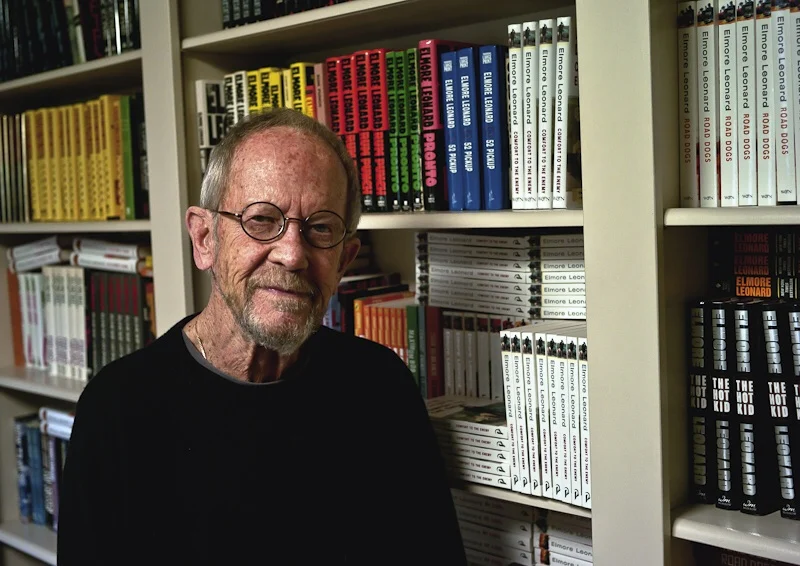
On the occasion of what would have been his 101st birthday, the literary world pauses to honor Elmore Leonard, a master storyteller whose distinctive voice redefined both Western and crime fiction. Born on October 11, 1925, in New Orleans, Leonard forged a career marked by sharp dialogue, morally ambiguous characters, and a relentless commitment to authenticity, leaving behind a legacy that continues to influence writers and filmmakers across genres. While later generations would primarily associate him with his quirky, critically acclaimed crime novels like Get Shorty and Out of Sight, Leonard’s foundational years were steeped in the dust and grit of the American West, where he honed his craft as a prolific author of Western novels and short stories for the vibrant pulp magazine market.
From Pulp to Prominence: Leonard’s Western Roots
Elmore Leonard’s journey into the literary landscape began not with the slick urban landscapes of Miami or Detroit, but with the expansive, untamed territories of the Old West. "Most of my early stuff was for the pulps," Leonard recounted in a 2007 interview with C&I magazine, reflecting on the 1950s, a golden era for these inexpensive, mass-produced magazines. The pulps, characterized by their rough paper, vivid cover art, and sensational stories, offered a crucial proving ground for aspiring writers. Leonard embraced the challenge, churning out tales of cowboys, outlaws, and lawmen with remarkable consistency.
His early work was driven by a need to make a living, and the economics of pulp fiction dictated both volume and speed. "All throughout the ’50s, when they were hot," he remembered, "I wrote 3:10 to Yuma in 1953, when I was 27. I got $90 for it — two cents a word for a 4,500-word story in Dime Western magazine. And let me tell you: In the ’50s, that wasn’t too bad." This seemingly modest sum was a significant income for a young writer at the time, underscoring the commercial viability of the genre and the sheer volume of material required to sustain a career. The pulps were a vital cultural force, providing escapism and adventure to millions of readers, and Leonard quickly distinguished himself with his taut narratives and believable characters.
Leonard’s Westerns were not merely conventional tales of good versus evil. Even in his early works, he displayed a nascent talent for subverting genre tropes, focusing on the psychological complexities of his characters and the often-grimy realities of frontier life. His characters were rarely purely heroic or villainous; instead, they were driven by a mix of desperation, greed, and a flawed sense of honor, echoing the moral ambiguities that would become a hallmark of his later crime fiction. This grounding in realistic character portrayal and dialogue, refined through his Western period, would prove invaluable as he transitioned to contemporary settings.
The Western Silver Screen: Adaptations of Leonard’s Early Works
Leonard’s knack for vivid storytelling and compelling characters quickly caught the attention of Hollywood. His Western stories, ripe with tension and dramatic potential, proved ideal for cinematic adaptation, contributing significantly to the genre’s enduring popularity throughout the mid-20th century. Here are some of the chief Western movies that bear the distinctive Elmore Leonard brand, many of which remain available for streaming today:
The Tall T (1957)
Budd Boetticher’s The Tall T stands as a quintessential example of the "Ranown Cycle," a series of highly acclaimed Westerns directed by Boetticher and starring Randolph Scott. Adapted from Leonard’s short story "The Captives," the film masterfully distills the author’s themes of survival, moral testing, and unexpected camaraderie under duress. Randolph Scott, in one of his iconic roles as ramrod-turned-rancher Pat Brennan, finds himself and copper mine heiress Doretta Mims (Maureen O’Sullivan) ensnared by a cunning stagecoach bandit, Frank Usher (Richard Boone), and his less-than-bright cohorts.
What elevates The Tall T beyond a standard abduction narrative is Leonard’s characteristic touch in character development. The bandit, Usher, notably refrains from immediately killing Brennan, driven primarily by a desperate craving for intelligent conversation after enduring the company of his oafish underlings. This nuanced portrayal of a villain, who possesses both brutality and a yearning for intellectual connection, is pure Leonard. The author himself lauded Richard Boone’s performance, recalling, "The great thing about Richard Boone is that he said his lines exactly the way I heard them in my head when I wrote the story. He did the same thing ten years later, when he appeared in the movie based on my book Hombre." Boone’s ability to capture the precise rhythm and understated menace of Leonard’s dialogue was a testament to both the actor’s skill and the author’s distinctive voice. The film is celebrated for its lean storytelling, psychological depth, and the stark, beautiful cinematography that defines Boetticher’s Westerns.
3:10 to Yuma (1957)
Perhaps the most famous and critically acclaimed of the early Leonard adaptations, the 1957 film 3:10 to Yuma, directed by Delmer Daves, remains a benchmark for psychological Westerns. Based on Leonard’s 1953 short story, this taut and intense drama stars a cast-against-type Glenn Ford as the charismatic, smooth-talking outlaw Ben Wade (a role later reprised by Russell Crowe in the 2007 remake). Opposite Ford, Van Heflin delivers a poignant performance as Dan Evans, a struggling, cash-strapped rancher determined to deliver Wade to a prison-bound train.
The premise is deceptively simple: transport a dangerous criminal from a small town to a distant railhead. However, Daves, a director renowned for his ability to generate suspense and explore complex human emotions within the Western framework (his other credits include Cowboy, The Hanging Tree, and Broken Arrow), elevates the film into a masterclass of tension. The primary impediment to Evans’ mission, naturally, is Wade’s loyal and ruthless gang of thieves and killers, constantly circling, seeking to free their leader. Yet, the film’s true brilliance lies in the edgy interplay between Heflin’s decent but skittish hero (a role Christian Bale would later embody) and Ford’s smugly self-confident rogue. Their exchanges are a dance of wills, with Wade continually probing Evans’ weaknesses, challenging his resolve, and offering temptations, all while Evans grapples with his own fears and moral obligations. The confined spaces, the ticking clock, and the escalating psychological warfare make 3:10 to Yuma a timeless study of courage, duty, and the seduction of evil.
Hombre (1967)
By the late 1960s, the Western genre was undergoing a significant shift, moving away from clear-cut heroes towards more morally ambiguous figures and revisionist themes. Hombre (1967) perfectly encapsulates this transition, serving as one of the key roles that cemented Paul Newman’s superstardom. Newman portrays John Russell, an Apache-reared outcast who finds himself reluctantly thrust into leadership when he and other stagecoach passengers are ambushed by bandits. These outlaws, led by a wolfish Richard Boone, are seeking booty embezzled by a corrupt Indian Affairs agent (Fredric March).
Directed by Martin Ritt, Hombre marked one of six collaborations between Newman and Ritt, a partnership that yielded powerful films like The Outrage (a Western based on Akira Kurosawa’s Rashomon) and Hud. Leonard’s original novel delves deep into themes of prejudice, cultural identity, and the clash between different ways of life. Newman’s stoic, capable, yet alienated "Hombre" (Spanish for man) is a complex hero, navigating a world that simultaneously fears and despises his Apache upbringing. His authoritative command in the face of crisis, contrasted with the bigotry of his fellow passengers, makes for compelling drama. Hombre received Leonard’s personal endorsement as a favorite among the many film adaptations of his works, a testament to its faithful capturing of his thematic concerns and character integrity.
Valdez Is Coming (1971)
As the 1970s dawned, the Western genre continued its evolution, embracing darker, more cynical narratives that reflected contemporary social anxieties. Valdez Is Coming (1971), based on Leonard’s novel, is a stark and brutal exploration of vengeance, class, and racial injustice. Burt Lancaster stars as Bob Valdez, an aging Mexican-American lawman who seeks compensation from the powerful Anglo landowner Frank Tanner (Jon Cypher) for the widow of a murder suspect killed on Tanner’s behalf. Tanner, a symbol of entrenched privilege and racism, responds with casual cruelty, ordering his flunkies to brutally beat and humiliate the constable. This, as Leonard’s stories often demonstrate, proves to be a very big mistake.
What follows is a relentless, almost mythic tale of a wronged man seeking justice against overwhelming odds. Valdez, despite his age and the brutal assault, methodically turns the tables on his tormentors, using his knowledge of the terrain and his skills as a frontiersman. Leonard himself expressed surprise and satisfaction with the film’s uncompromising ending. "I was surprised they were able to get away with the ending," Leonard said. "I mean, there’s no final gunfight [between Valdez and Tanner]. Even the studio couldn’t believe it. But they let [director Edwin Sherin] do it anyway." This decision to forgo a conventional showdown, instead opting for a more ambiguous yet equally satisfying form of retribution, perfectly aligned with Leonard’s preference for realism over genre clichés, making Valdez Is Coming a powerful, unforgettable entry in the revisionist Western canon.
Joe Kidd (1972)
Joe Kidd (1972) saw Clint Eastwood, fresh off his iconic spaghetti Westerns and his directorial debut with Play Misty for Me, stepping into the role of a hard-drinking but straight-shooting anti-hero. The film explores themes of land rights and social justice as Eastwood’s character, Joe Kidd, initially agrees to help a ruthless railroad tycoon, Frank Harlan (Robert Duvall), ride roughshod over Mexican landowners. However, Kidd experiences a change of heart, ultimately siding with the oppressed.
The production of Joe Kidd was notably challenging from a screenwriting perspective. Leonard continued to rewrite (and re-re-write) his original screenplay long after production had commenced, a testament to the collaborative, sometimes tumultuous, nature of filmmaking. "I took suggestions from [director John Sturges]," Leonard admitted, "but that didn’t help the film at all." Despite Leonard’s reservations about the final product, the film featured strong performances, particularly from Robert Duvall. Leonard held Duvall’s work in high esteem: "I don’t think Duvall could ever give a bad performance. He always becomes the character — and he makes it look so easy." Duvall’s portrayal of the villainous Harlan added significant depth to a film that, while perhaps not fully realizing Leonard’s vision, remains a compelling exploration of a common Western theme: the struggle between powerful interests and the dispossessed.
Last Stand at Saber River (1997)
Decades after his initial Western boom, Elmore Leonard’s stories continued to find new life on screen. Last Stand at Saber River (1997) is arguably one of the best of several made-for-cable Westerns that showcased the charismatic Tom Selleck, who had a strong affinity for the genre. This unabashedly old-fashioned yet enjoyably exciting drama, based on Leonard’s novel, brings the author’s signature realism to a post-Civil War setting.
Selleck stars as an ex-Confederate cavalryman seeking a new life with his strong-willed wife (Suzy Amis) and their two children (a young Haley Joel Osment and Rachel Duncan) on an Arizona homestead. The promise of peace is shattered when two Union-sympathizing brothers, played by real-life siblings Keith and David Carradine, lay claim to the same land, leading to a tense and ultimately violent confrontation. The film captures the raw struggle of homesteaders, the lingering bitterness of the Civil War, and the fierce determination of a family fighting for their future. It’s a testament to Leonard’s enduring appeal that his novels continued to inspire compelling Western narratives well into the late 20th century, proving that his themes and character types were timeless.
The Enduring Legacy: From Westerns to Justified
While Elmore Leonard’s early career was defined by his contributions to the Western genre, he ultimately transitioned to become one of the most celebrated crime fiction writers of his time. However, the influence of his Western roots never truly left him. His unique blend of crisp, authentic dialogue, cynical humor, and a focus on characters navigating morally ambiguous situations found a perfect modern expression in his crime novels.
This fusion of genres culminated brilliantly in the popular TV series Justified (2010-2015), which brought Leonard’s U.S. Marshal Raylan Givens to the screen. As C&I readers know full well, Justified perfectly captured Leonard’s vision, featuring a lawman who wore a cowboy hat and enforced a brand of frontier justice in contemporary Harlan County, Kentucky. Givens, with his quiet confidence, sharp wit, and willingness to bend rules for the sake of his own moral code, is essentially a modern-day Western hero, transplanted into the world of drug dealers, family feuds, and organized crime. The series, which ran for six critically acclaimed seasons, proved that the spirit of Elmore Leonard’s Westerns — the clash of strong personalities, the pursuit of justice outside conventional lines, and the constant threat of violence simmering beneath the surface — could thrive in a contemporary setting. Justified not only introduced Leonard’s distinctive style to a new generation but also solidified his place as a master of character-driven storytelling, regardless of the era or landscape.
Elmore Leonard’s 101st birth anniversary serves as a powerful reminder of a literary giant whose work transcended genre boundaries. From the dusty trails and desperate men of his pulp Westerns to the gritty streets and complex criminals of his later crime fiction, Leonard’s commitment to authentic voice, compelling dialogue, and deeply human characters remains his defining legacy. His stories, whether set in the Old West or modern America, continue to resonate, proving that a true master storyteller’s influence knows no bounds.