

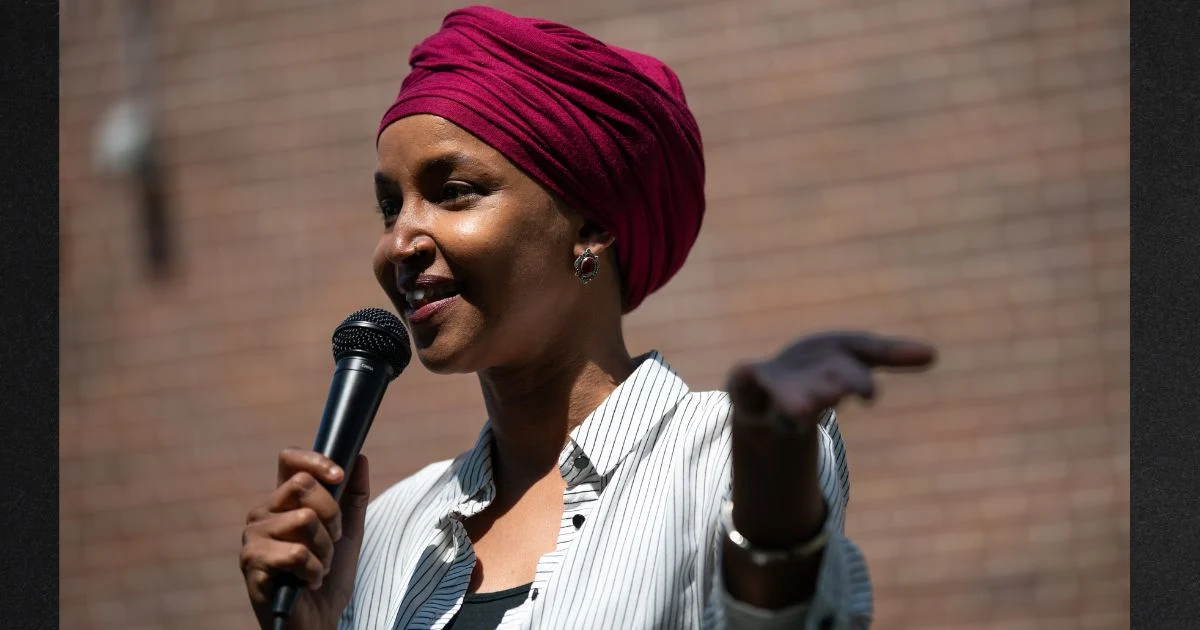
A federal raid on the Washington D.C. residence of U.S. Representative Ilhan Omar, a prominent Minnesota Democrat, on Monday has brought renewed scrutiny to her past, with a recent report from the New York Post alleging that her staff altered her official birthdate in public records after her election to Congress in 2018. This development has fueled long-standing speculation regarding her immigration status, a subject of recurrent controversy throughout her political career. While federal authorities have not officially disclosed the reason for the raid, which occurred just a day prior to the New York Post’s report, its timing has intensified public and political interest in the various investigations surrounding the congresswoman.
The New York Post’s investigation, based on emails it claims to have obtained and reviewed, suggests a change in Omar’s birthdate from October 4, 1981, to October 4, 1982. This seemingly minor, one-year discrepancy carries significant implications, particularly concerning the legal requirements for obtaining derivative U.S. citizenship. Critics argue that if Omar was indeed born in 1981, she would have been 18 years old in 2000, the year she reportedly obtained her U.S. citizenship through her father’s naturalization. Under U.S. immigration law at the time, a child could only derive citizenship from a naturalized parent if they were still a minor (under 18) when the parent completed the naturalization process.
Background on Representative Ilhan Omar’s Political Trajectory
Ilhan Omar’s journey to the U.S. Congress is a remarkable one, reflecting the complexities of modern immigration and American politics. Born in Mogadishu, Somalia, in 1982 (according to her publicly listed and now disputed birthdate), Omar and her family fled the Somali civil war, spending four years in a refugee camp in Kenya before immigrating to the United States in 1995. The family settled in Arlington, Virginia, and later Minneapolis, Minnesota. Omar became a U.S. citizen in 2000.
Her political career began with her election to the Minnesota House of Representatives in 2016, making her the first Somali-American to be elected to legislative office in the United States. In 2018, she successfully ran for the U.S. House of Representatives for Minnesota’s 5th congressional district, becoming one of the first two Muslim women (alongside Rashida Tlaib) and the first naturalized African refugee to serve in Congress. As a member of "The Squad," a group of progressive Democratic congresswomen, Omar has been a vocal advocate for issues ranging from universal healthcare and climate action to immigration reform. Her outspokenness and progressive stances have often placed her at the center of national political debates, drawing both ardent support and intense criticism.
Throughout her tenure, Omar has faced various accusations and controversies, including allegations of campaign finance violations, marital issues, and repeated questioning of her immigration history and identity. These past controversies, though often dismissed by Omar as politically motivated attacks, contribute to the heightened sensitivity surrounding the current allegations and investigations.
The Intricacies of Derivative Citizenship
Understanding the allegations requires a clear grasp of derivative citizenship, a process by which children automatically become U.S. citizens when their parents naturalize. Prior to February 27, 2001, Section 321 of the Immigration and Nationality Act (INA) governed derivative citizenship. Under this statute, a child born outside the United States automatically acquired U.S. citizenship if:
- One or both parents naturalized.
- The child was under 18 years of age at the time of the parent’s naturalization.
- The child was residing in the United States as a lawful permanent resident (LPR) in the legal and physical custody of the naturalizing parent.
Crucially, the age requirement of "under 18" is central to the allegations against Omar. If her true birthdate is October 4, 1981, she would have turned 18 on October 4, 1999. If her father naturalized in 2000, as generally understood, and she was born in 1981, she would have been 18 or older at the time, thus potentially ineligible for derivative citizenship under the then-prevailing law. Conversely, if her birthdate is indeed October 4, 1982, she would have been 17 years old in 2000, thereby meeting the age requirement for derivative citizenship. The alleged alteration of this single digit, therefore, becomes a pivotal point in validating or invalidating her claim to U.S. citizenship acquired through her father.
Chronology of Allegations and Events
The timeline of events surrounding Ilhan Omar’s identity and immigration status has been punctuated by recurring questions and challenges:
- 1981 or 1982: The core of the current controversy lies in her true birth year. Her publicly listed birthdate has long been October 4, 1981.
- 1995: Omar and her family arrive in the United States as refugees.
- 2000: Omar reportedly obtains U.S. citizenship through her father’s naturalization.
- 2016: Omar is elected to the Minnesota House of Representatives.
- 2018: Omar is elected to the U.S. House of Representatives. This marks her entry into federal office, increasing public scrutiny.
- May 2019: According to emails cited by the New York Post, Omar’s staff allegedly initiated the change of her birthdate in public records from 1981 to 1982. This occurred several months after she assumed her congressional seat.
- 2022: AJ Kern, a Republican political opponent who ran against Omar in the Democratic primary for Minnesota’s Fifth District (despite being a Republican, she challenged Omar in the Democratic primary for strategic reasons, though she came in a distant fourth), publicly questions Omar’s citizenship narrative. Kern specifically highlights the age requirement for derivative citizenship, stating, "She claims her citizenship narrative is that she derived citizenship through her father when she was a 17-year-old minor. For derivative citizenship, two things have to be true — one, her father had to naturalize; and two, she still had to be a minor — and what I have found is that it’s highly likely that neither of those things are true." Kern also filed a complaint with the Federal Election Commission (FEC) demanding proof of Omar’s citizenship.
- Post-2022 FEC Complaint: Kern reported that her FEC complaint "went nowhere because a judge found it was ‘the job of Congress to vet their members.’" This highlights a jurisdictional challenge in resolving such allegations through administrative channels.
- October 12, 2026 (Monday): Federal agents raid Representative Omar’s D.C. residence. The specific nature and target of the investigation leading to the raid remain undisclosed by federal authorities.
- October 13, 2026 (Tuesday): The New York Post publishes its report detailing the alleged birthdate alteration by Omar’s staff in 2019, directly linking it to the ongoing questions about her immigration status and the broader federal interest in her affairs.
Supporting Data and Precedent
The legal framework surrounding naturalization and derivative citizenship is complex, with specific requirements that must be met at the time of the event. The interpretation of "minor" status, generally understood as under 18 years of age, is critical. Any discrepancy in a birthdate that shifts an individual’s age across this threshold at a crucial moment of citizenship acquisition could have profound legal ramifications.
While direct comparisons are rare given the unique circumstances of a sitting U.S. Congress member, cases involving individuals whose citizenship status has been challenged due to age discrepancies or fraudulent claims have been seen in various contexts. Such cases often involve detailed reviews of birth records, immigration documents, and family histories. The burden of proof typically lies with the individual to demonstrate they met all legal requirements at the time citizenship was acquired.
Furthermore, the act of a public official or their staff allegedly altering official records, regardless of the motivation, raises questions of transparency, ethics, and potential legal misconduct. Public records, especially those pertaining to identity and legal status, are expected to be accurate and unmanipulated.
Official Responses and Lack Thereof
As of the latest reports, Representative Ilhan Omar and her official representatives have not issued a specific statement directly addressing the New York Post’s allegations regarding the alteration of her birthdate. In the past, Omar has vehemently denied any wrongdoing regarding her immigration status or personal identity, often characterizing such inquiries as xenophobic or Islamophobic attacks aimed at discrediting her. Her consistent position has been that she is a lawful U.S. citizen who followed all proper procedures.
Regarding the federal raid on her residence, official statements from federal agencies, such as the Department of Homeland Security (DHS) or the FBI, have been absent or limited to acknowledging an ongoing investigation without disclosing specifics, a standard practice in such matters to protect the integrity of the probe. The lack of detailed information from federal authorities often leads to increased public speculation and reliance on investigative reports from media outlets.
The FEC’s decision regarding AJ Kern’s complaint – that it was "the job of Congress to vet their members" – highlights a gap in enforcement mechanisms for such specific allegations. While Congress does have the authority to investigate its members, such investigations are often politically charged and can be difficult to initiate without bipartisan consensus or overwhelming evidence. This leaves individuals like Kern with limited avenues for formal resolution of their concerns outside of the judicial or executive branches.
Broader Impact and Implications
The new allegations, coupled with the federal raid, carry significant implications across legal, political, and public trust dimensions.
- Legal Implications: If the allegations of birthdate alteration are substantiated, and it is proven that Omar did not meet the age requirement for derivative citizenship in 2000, it could potentially lead to a re-evaluation of her citizenship status. While the process for revoking citizenship is complex and typically requires demonstrating fraud or misrepresentation at the time of naturalization, these new claims could provide grounds for such an inquiry. Furthermore, the act of allegedly altering public records could itself constitute a separate legal offense, depending on the intent and nature of the changes.
- Political Implications: For Representative Omar, these allegations present a substantial political challenge. They could erode trust among some constituents and provide ammunition for political opponents. Even if the claims are ultimately disproven, the specter of an ongoing federal investigation and questions about her identity could distract from her legislative agenda and complicate future electoral campaigns. For the Democratic Party, these controversies could become a liability, particularly in competitive electoral environments, forcing them to defend a high-profile member against serious accusations. Conversely, her supporters may view these events as further evidence of targeted political harassment.
- Impact on Public Trust: At a broader level, allegations concerning the integrity of public officials’ identities and the manipulation of official records can significantly undermine public trust in government institutions and elected representatives. In an era already marked by deep political polarization and skepticism, such controversies contribute to a narrative of opacity and potential malfeasance, regardless of the ultimate outcome of any investigation. They also highlight the challenges in verifying the backgrounds of public figures, especially when immigration and identity documents from other countries are involved.
- Precedent and Congressional Standards: Should these allegations lead to formal action, they could set a precedent for how Congress and federal agencies investigate and address issues of member eligibility and the accuracy of personal information provided by elected officials. It may prompt a review of vetting processes for candidates and members of Congress, especially concerning complex immigration histories.
The unfolding situation surrounding Representative Ilhan Omar is a multifaceted story involving federal law enforcement, immigration law, political scrutiny, and the integrity of public records. As investigations continue and more details emerge, the full scope of the legal and political ramifications for the congresswoman and the broader political landscape will become clearer. The public awaits official statements and conclusive findings to ascertain the veracity of these grave allegations.









