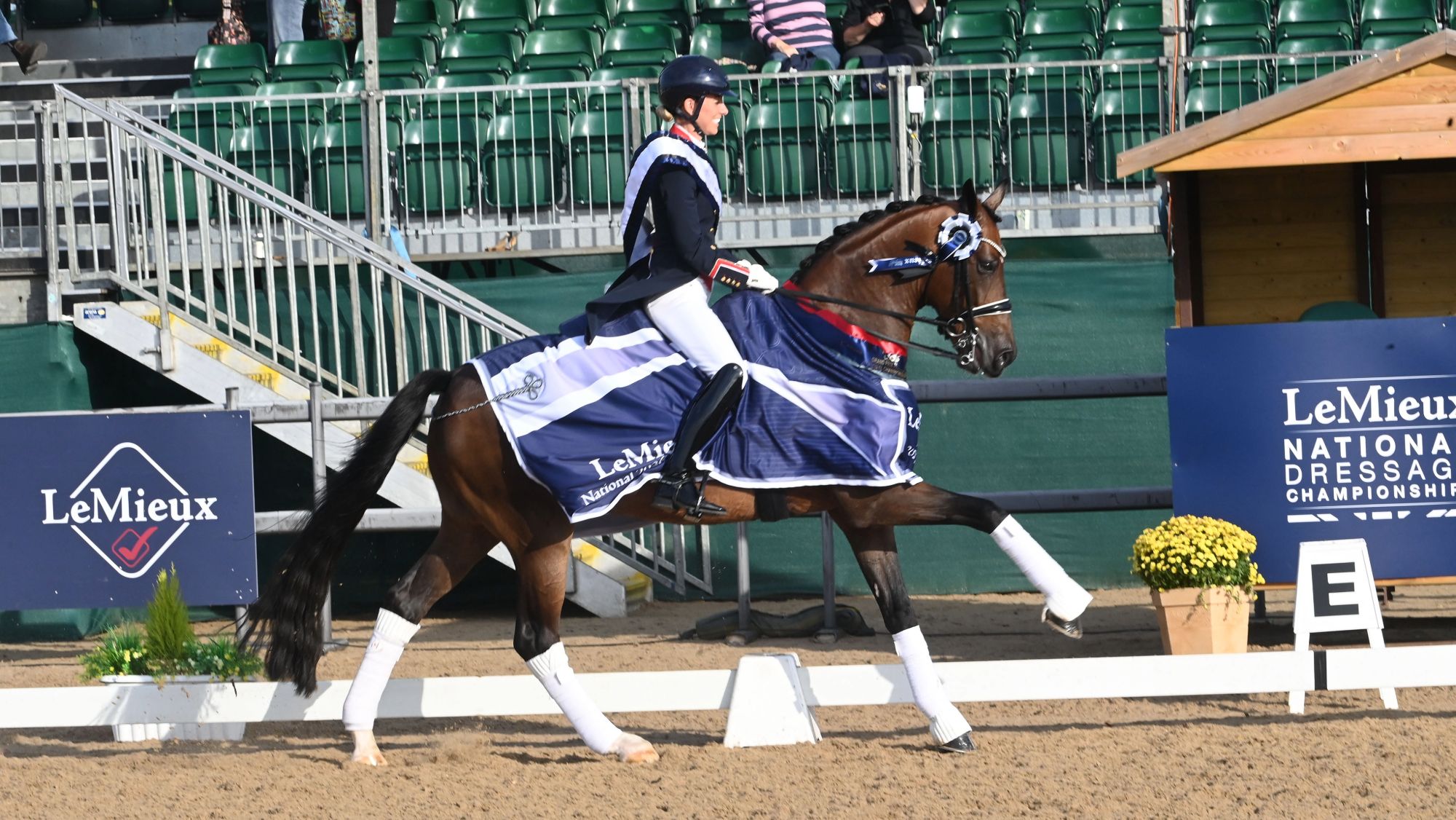
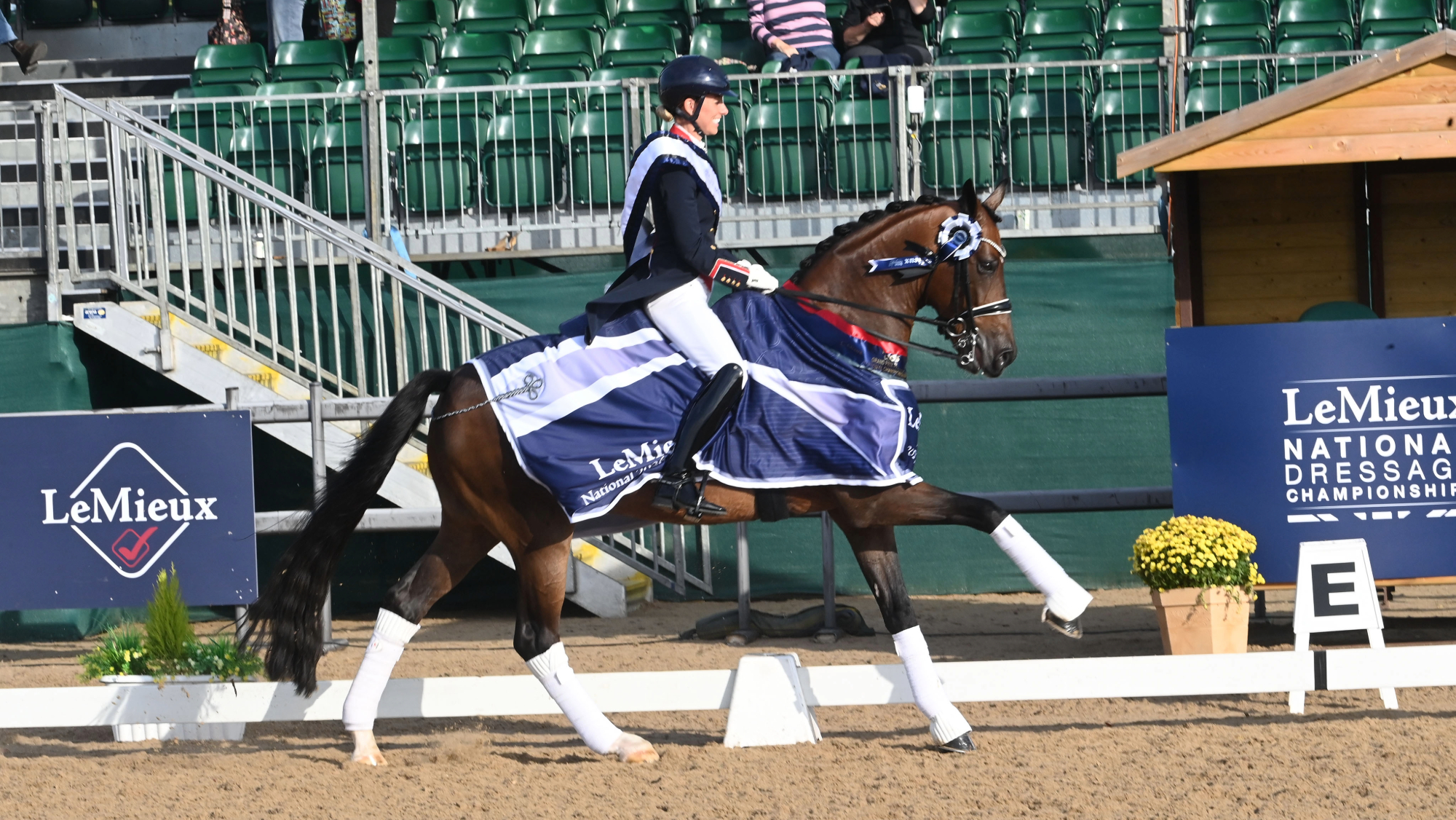
Charlotte Dujardin has once again ascended to the pinnacle of British dressage, securing the coveted national championship title at the 2026 LeMieux National Dressage Championships. Riding the promising Brave Heart II, Dujardin delivered a stellar performance in the Kudos freestyle, achieving a remarkable score of 79.4%. This victory marks her third national championship title and signifies a significant milestone for both rider and horse, as it was their inaugural Grand Prix Freestyle (kur) competition together.
The prestigious national title is awarded based on the combined scores from the Grand Prix and the Grand Prix Freestyle. Dujardin’s dominance was evident from the outset; her Grand Prix performance alone had already established a commanding lead, exceeding her nearest competitor by over five percentage points. This substantial advantage ensured that her freestyle performance, while impressive in its own right, solidified her position at the top of the leaderboard, leaving no doubt about her championship status.
The 2026 LeMieux National Dressage Championships, held at a yet-to-be-specified venue, represent a key fixture in the British equestrian calendar. The event draws together the nation’s elite dressage combinations, offering a platform for both established stars and emerging talents to showcase their skills and compete for national honours. The championships serve not only as a test of individual prowess but also as a crucial indicator of the strength and depth of British dressage talent, often influencing selection for international competitions and future Olympic campaigns.
A Career Defined by Excellence: Dujardin’s National Championship Pedigree
Charlotte Dujardin’s achievement at the 2026 championships adds another illustrious chapter to her already legendary career. Her previous national championship victories were secured in 2015 aboard Barolo and in 2020 with the exceptional Mount St John Freestyle. These past successes underscore her consistent ability to perform at the highest level, adapting to different equine partners and maintaining an unwavering competitive edge over more than a decade.
Brave Heart II, a relatively newer partner for Dujardin, has demonstrated remarkable potential. The horse’s performance in his first Grand Prix Freestyle alongside Dujardin indicates a strong partnership and a bright future for the duo on the international stage. The development of new equine partnerships is a testament to Dujardin’s skill as a trainer and her dedication to nurturing talent.
The Path to Victory: Grand Prix Dominance and Freestyle Flourish
The journey to the national title began with the Grand Prix, a demanding test of a horse’s obedience, athleticism, and harmony with its rider. Dujardin and Brave Heart II’s performance in this phase set a formidable benchmark. While specific scores for the Grand Prix are not detailed in the initial report, the statement that her score was "more than five percentage points clear of her nearest rival" highlights a significant margin of superiority. This level of dominance suggests a near-flawless execution of the Grand Prix test, likely characterized by powerful and accurate movements, seamless transitions, and a deep connection between horse and rider.
The Grand Prix Freestyle, or kur, is where combinations demonstrate their artistry and precision to music. The score of 79.4% achieved by Dujardin and Brave Heart II in their debut kur is a strong indicator of their potential. A freestyle test requires not only technical accuracy in executing the required movements but also creativity in the choreography and a harmonious integration with the chosen music. Achieving such a score in their first outing suggests that the partnership is already well-rehearsed and that Brave Heart II possesses the temperament and athleticism to excel in this more expressive discipline.
Context of the Championships: A Crucial Stepping Stone
The LeMieux National Dressage Championships are more than just a competition; they are a vital part of the development pathway for British dressage. For riders like Dujardin, it’s an opportunity to fine-tune their Grand Prix and Freestyle tests in a high-pressure environment before heading to major international events such as European Championships, World Championships, and Olympic Games. For younger or less experienced horses and riders, it offers invaluable experience in a championship setting, helping them to build confidence and learn to perform under scrutiny.
The sponsorship by LeMieux, a prominent equestrian brand, further elevates the profile of the championships, providing significant support and enhancing the overall experience for competitors and spectators alike. This partnership signifies the growing commercial interest and investment in dressage, reflecting the sport’s increasing popularity and professionalization.
Supporting Data and Performance Metrics
While the provided text focuses on Dujardin’s win, a comprehensive understanding of the championships would typically involve a broader analysis of performance metrics. This would include:
- Average Scores: The average scores across all competitors in both the Grand Prix and Freestyle classes would provide context for Dujardin’s performance. A higher average score across the field might indicate a more competitive year, while a lower average could suggest challenging conditions or a higher standard of judging.
- Top Competitors: Identifying the other high-ranking competitors and their scores would offer insight into the depth of talent present. Understanding who finished second and third, and the scores they achieved, would paint a clearer picture of the competitive landscape.
- Movement Scores: In dressage, judges award scores for specific movements (e.g., extended trot, canter pirouettes, half-passes). A detailed breakdown of these scores for the top combinations can reveal strengths and weaknesses, offering a more nuanced understanding of their performances.
- Harmony and Rider Marks: Judges also award marks for harmony between horse and rider, as well as general impression. These subjective marks, while influenced by objective execution, are crucial for overall scores and can highlight the quality of the partnership.
Inferred Reactions and Future Implications
While direct quotes from Dujardin are not included, her consistent success speaks volumes. Her continued dedication to the sport, even after achieving unparalleled Olympic success, is a testament to her passion and competitive spirit. Her partnership with Brave Heart II is likely a source of great satisfaction, representing the ongoing evolution of her career and her ability to bring out the best in different horses.
For Brave Heart II, this victory is a significant career highlight. As a relatively new partner, demonstrating such immediate success at the national level suggests he has the qualities to potentially follow in the footsteps of Dujardin’s previous champion horses. This win will undoubtedly boost his confidence and prepare him for the more demanding international circuit.
The implications of this victory extend beyond Dujardin and Brave Heart II. It reinforces Great Britain’s position as a leading nation in dressage. Dujardin’s continued presence at the top serves as an inspiration to aspiring riders and a benchmark for the sport’s development within the country. It also signals a strong pipeline of talent, with new partnerships emerging and proving their mettle.
A Glimpse into the Author’s Expertise
The article is attributed to Oscar Williams, H&H dressage and sport horse editor. His background in equine science and his experience working with leading dressage rider Emile Faurie, including competing at the National Dressage Championships himself, provides him with a deep understanding of the sport. His master’s degree in Literature also suggests a strong command of language and narrative, which he likely brings to his editorial work. This expertise ensures that the reporting on dressage events is both knowledgeable and insightful.
The Chronology of a Championship Season
While the provided text is a snapshot of the final results, a typical championship season involves a build-up of events. The National Dressage Championships usually follow a series of regional and national qualifiers. Combinations must first achieve certain dressage levels and scores throughout the year to qualify for the prestigious event. This ensures that only the most consistent and highest-performing combinations reach the championship finals. The schedule at the championships themselves is often packed, with various levels and disciplines competing over several days. The Grand Prix typically takes place first, followed by the Grand Prix Special and the Grand Prix Freestyle, allowing judges and officials ample time to assess the performances.
Analysis of Dujardin’s Strategy and Horse Development
Charlotte Dujardin’s approach to developing and competing with Brave Heart II, culminating in their first Grand Prix Freestyle victory at the National Championships, warrants closer examination. The decision to debut a Grand Prix Freestyle at such a significant national event indicates a high level of confidence in the horse’s training and readiness. It also suggests a strategic approach to competition, prioritizing performance development in a high-stakes environment.
The success in their debut freestyle points to several key factors:
- Sound Training Foundation: Brave Heart II must possess a strong foundation in the advanced dressage movements, including piaffe, passage, pirouettes, and flying changes. Dujardin’s expertise lies in bringing horses through these stages with correctness and suppleness.
- Temperament and Trainability: The ability to perform a Grand Prix Freestyle requires a horse with a calm and focused temperament, capable of handling the pressure of competition and responding positively to the music. Brave Heart II’s performance suggests he has these qualities.
- Partnership Development: The success in a first kur is not solely down to the horse; it also reflects the strength of the partnership. Dujardin’s ability to communicate effectively with Brave Heart II, guiding him through the complex test with precision and fluidity, is paramount. This indicates a well-developed rapport built on trust and understanding.
- Music and Choreography: While not detailed, the choice of music and the choreography of the freestyle test play a crucial role in maximizing a horse’s potential. A well-matched program can highlight a horse’s strengths and mask any minor weaknesses, contributing to a higher score.
The Broader Impact on the Equestrian World
The continued success of riders like Charlotte Dujardin has a ripple effect across the equestrian world. It inspires a new generation of riders to pursue dressage with dedication and ambition. Furthermore, it drives innovation in training methods, equine care, and equestrian technology, as riders and their teams constantly seek ways to improve performance. The visibility generated by such high-profile victories also attracts sponsorship and media attention, contributing to the overall growth and professionalization of the sport.
The LeMieux National Dressage Championships, by providing a platform for these elite performances, play a vital role in this ecosystem. They are a celebration of equestrian excellence and a testament to the hard work, dedication, and passion of the athletes and their support teams. As Charlotte Dujardin adds another national title to her impressive collection, she not only solidifies her legacy but also continues to elevate the sport of dressage in Britain and on the global stage. The emergence of Brave Heart II as a top-tier competitor alongside her further underscores her enduring talent and her commitment to nurturing future champions.