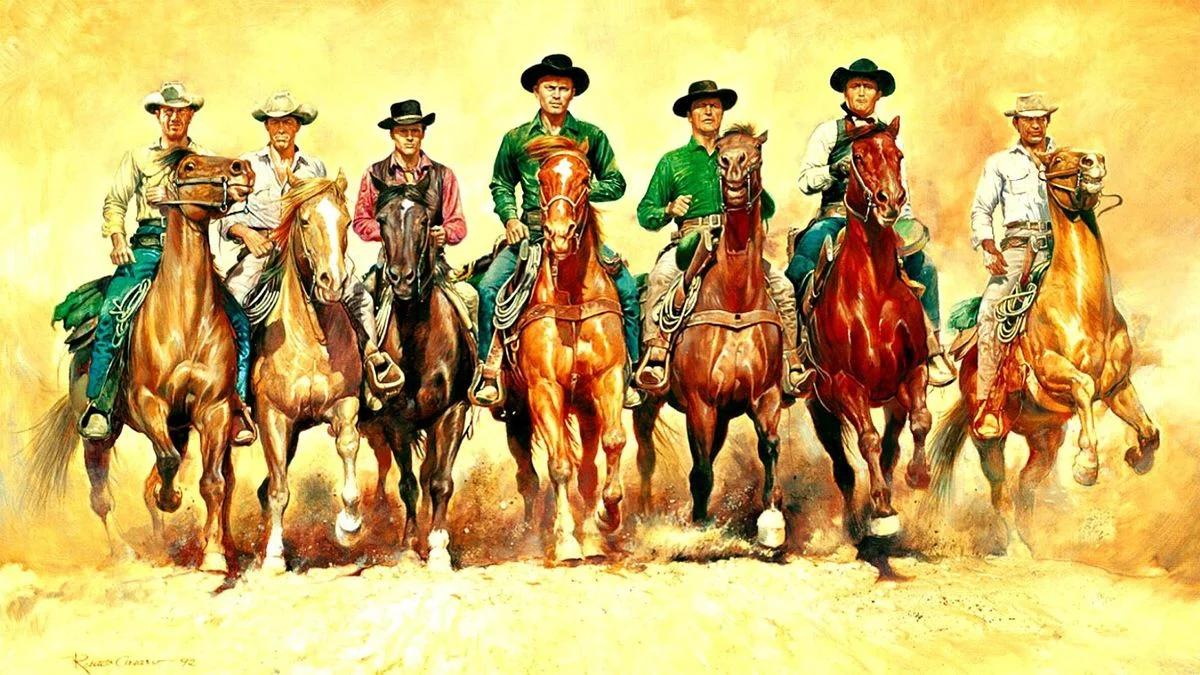
Director John Sturges encountered more than his share of obstacles while assembling his ideal team for the 1960 western, a film that would indelibly stamp its mark on cinematic history and transcend the traditional boundaries of the genre.
A Bridge Between Eras: The Western’s Evolution
The Magnificent Seven, released in 1960, stands as a pivotal film, skillfully bridging the gap between the psychologically complex, often darker adult westerns of the 1950s and the gritty, morally ambiguous spaghetti westerns that would dominate the 1960s. At its heart, the film is an action-adventure tale of hired guns seeking redemption by defending Mexican villagers against a ruthless bandit leader. Its immense popularity and enduring influence are testament to its compelling narrative and iconic ensemble cast.
The film’s genesis lies in a renowned Japanese action-adventure, Akira Kurosawa’s 1954 masterpiece Seven Samurai. Kurosawa himself drew inspiration from the classic American westerns of directors like John Ford, creating a fascinating cross-cultural cinematic dialogue. Sturges, working with this rich source material and a roster of burgeoning young stars, inadvertently established a template that would inspire countless sequels, imitations, homages, remakes, and television spinoffs. Despite the numerous interpretations, the 1960 original remains in a class by itself, often cited as a gateway western for those unfamiliar with the genre. It masterfully blends a rousingly old-fashioned tale of courage and sacrifice with a thoughtfully revisionist meditation on the inherent complexities and costs of living by the gun.
The Narrative Core: Justice in a Lawless Land
The story centers on Chris Adams, portrayed by Yul Brynner in what would become a signature role. Chris is a man in black, a stoic and skilled gunfighter, leading a band of equals whose primary expertise lies in their lethal proficiency. His pragmatic view of his abilities, encapsulated in his assertion to a young admirer – “It’s only a matter of knowing how to shoot a gun. Nothing big about that” – belies the profound impact such skill has in a world where justice is often bought with lead.
This expertise is desperately needed by the impoverished Mexican farmers whose remote village is subjected to relentless plunder by Calvera, a preening and unapologetic bandit leader brought to life with chilling charisma by Eli Wallach. Calvera’s disdain for the helpless is clear in his cynical philosophy: “If God did not want them sheared, he would not have made them sheep.”
Under normal circumstances, Chris Adams avoids pro bono work. However, the villagers’ plight, and their offer of "everything" they possess as meager compensation, stirs something within him. His recognition of this profound sacrifice – “I have been offered a lot for my work. But never ‘everything’” – becomes the catalyst for his commitment. In a period when, as one character notes, “men are cheaper than guns,” Adams finds it surprisingly feasible to assemble a formidable team of six other straight shooters.
A Race Against Time: The Perilous Casting Process
The assembly of this impressive cast was, as actor Robert Vaughn later recalled in his 2008 autobiography, A Fortunate Life, largely a "happy accident" or a stroke of luck, driven by an unforeseen industry crisis. Director John Sturges, already a seasoned hand in the western genre with credits including Last Train From Gun Hill, Gunfight at the O.K. Corral, and The Law and Jake Wade, faced a significant impediment during pre-production for The Magnificent Seven: a looming Screen Actors Guild (SAG) strike scheduled to commence in the spring of 1960.
This impending strike cast a long shadow over every film project in Hollywood. As Vaughn detailed, "an ax was hanging over every movie project in Hollywood" because "unless the casting for a picture was completed by noon on a particular Friday, production couldn’t begin." With that critical deadline barely a month away, Sturges had only managed to secure two of his titular roles: Yul Brynner, who was instrumental in championing the idea of adapting Seven Samurai into a western, and Steve McQueen, then gaining recognition for his gritty portrayal of a bounty hunter in the popular TV series Wanted Dead or Alive.
Sturges, having been impressed by Vaughn’s Oscar-nominated performance as a traumatized Korean War veteran in 1959’s The Young Philadelphians, knew he wanted the rising actor for his next project. The immediate challenge was the lack of a complete script. Sturges candidly informed Vaughn, "We don’t have a script, just Kurosawa’s picture to work from. You’ll have to go on faith." He sweetened the deal with the promise of filming in Cuernavaca, Mexico, describing it as "the Palm Springs of Mexico." Vaughn, sensing the opportunity, readily agreed. Sturges, seizing the moment, then asked, "And do you know any other good young actors? I’ve got four other slots to fill." This desperate plea, born of the strike deadline, would prove instrumental in shaping the film’s iconic ensemble.
The Ensemble: Crafting the Legendary Seven
Vaughn’s immediate recommendation was James Coburn, a friend and former classmate who had recently made an impression in Budd Boetticher’s 1959 western Ride Lonesome. Coburn, in the documentary Guns for Hire: The Making of The Magnificent Seven, recounts a serendipitous encounter with Vaughn at an L.A. supermarket where he learned of the opportunity. Coburn’s casting as Britt, the quiet, almost zen-like knife thrower, added another layer of cool competence to the group.
The remaining slots were filled swiftly. Charles Bronson, who would go on to become a major action star, was cast as Bernardo O’Reilly, a half-Irish, half-Mexican gunfighter who forms an unexpected bond with the village children. Brad Dexter took on the role of Harry Luck, the cynical, money-motivated member of the group, convinced there’s a hidden treasure. Horst Buchholz, a German actor, was an "improbably but effectively" cast as Chico, the eager young Mexican seeking to prove himself and representing the villagers’ future. Each actor brought a distinct personality and skill set, contributing to the dynamic chemistry of the group.
For the pivotal role of the antagonist, Sturges turned to New York stage actor Eli Wallach. Initially, Wallach expressed concern about the limited screen time for his character, Calvera. However, upon a second reading of the script, he realized the immense narrative weight of Calvera’s presence. As Wallach wrote in his autobiography, “I realized that even though I only appeared in the first few minutes of the film, the natives spoke about my return for the next 45 minutes… ‘Calvera’s coming.’ ‘When is he coming back?’ so, I decided to do the part.” This keen understanding of his character’s looming threat allowed Wallach to imbue Calvera with a menacing presence that extended beyond his actual screen time, making him one of cinema’s most memorable villains.
Behind the Scenes: Artistic Choices and Production Nuances
The filming location in Cuernavaca, Mexico, offered the perfect sun-drenched, rugged backdrop for the Western narrative. Cinematographer Charles Lang Jr., known for his ability to capture expansive landscapes and dramatic action, contributed significantly to the film’s visual appeal, grounding the heroic deeds in a tangible, if romanticized, reality.
One notable regret expressed by Eli Wallach concerned the film’s iconic musical score by Elmer Bernstein. Wallach lamented not hearing Bernstein’s unforgettable composition until long after principal photography had wrapped. He believed that if he had, his performance, particularly his horsemanship, might have been different. "If I had heard that score," Wallach wrote, "I think I would have ridden my horse differently." He recalled how, in the silent film era, mood music was often played on set to enhance actors’ performances. Wallach also shared an amusing anecdote about Sturges teasing him for his unusual riding style: "Why do you always type while galloping?" Sturges asked, observing Wallach’s left hand bouncing as if on a typewriter. This lighthearted moment offers a glimpse into the collaborative yet sometimes challenging dynamic on set.
The film’s production budget was approximately $2 million, a considerable sum for its time, reflecting the scale of the production and the caliber of its cast. Despite the rushed casting process and logistical challenges, Sturges managed to create a cohesive and powerful cinematic experience.
Enduring Impact and Legacy
Upon its release, The Magnificent Seven was a significant commercial success, grossing an impressive $9.3 million at the box office. Critics largely lauded its thrilling action sequences, the compelling performances of its ensemble cast, and its sophisticated blend of classic Western tropes with a more contemporary, introspective approach. While some initially found it to be a faithful but not necessarily superior remake of Seven Samurai, its unique strengths, particularly its iconic score and the charismatic interplay of its stars, quickly established it as a classic in its own right.
The film’s cultural impact extends far beyond its initial reception. Elmer Bernstein’s main theme became synonymous with the Western genre, influencing countless scores and becoming instantly recognizable worldwide. The character archetypes established within the film—the stoic leader, the hot-headed youngster, the quiet professional, the cynical opportunist, the haunted veteran, the family man, and the charismatic rogue—have been echoed in numerous ensemble action films across genres, from Star Wars to A Bug’s Life.
The success of The Magnificent Seven spawned a franchise, including three sequels: Return of the Seven (1966), Guns of the Magnificent Seven (1969), and The Magnificent Seven Ride! (1972), as well as a short-lived television series in the late 1990s. A big-budget remake was released in 2016, starring Denzel Washington and Chris Pratt, demonstrating the enduring appeal of the core narrative. However, none have quite captured the magic and cultural resonance of the 1960 original, which perfectly balanced thrilling action with nuanced character development and thematic depth.
In the end, neither Calvera nor the gunfighters emerge as true victors in the conventional sense. The meek—the Mexican farmers—are the ones who ultimately inherit the earth, having secured their future through the costly intervention of outsiders. Yet, Chris, Vin, and their five cohorts achieve a different kind of victory: they become legends, living or otherwise, by staying true to their word, being quick with their guns, and, most importantly, by proving themselves truly magnificent. The film remains a timeless testament to courage, sacrifice, and the complex nature of heroism in a world that often demands difficult choices.