

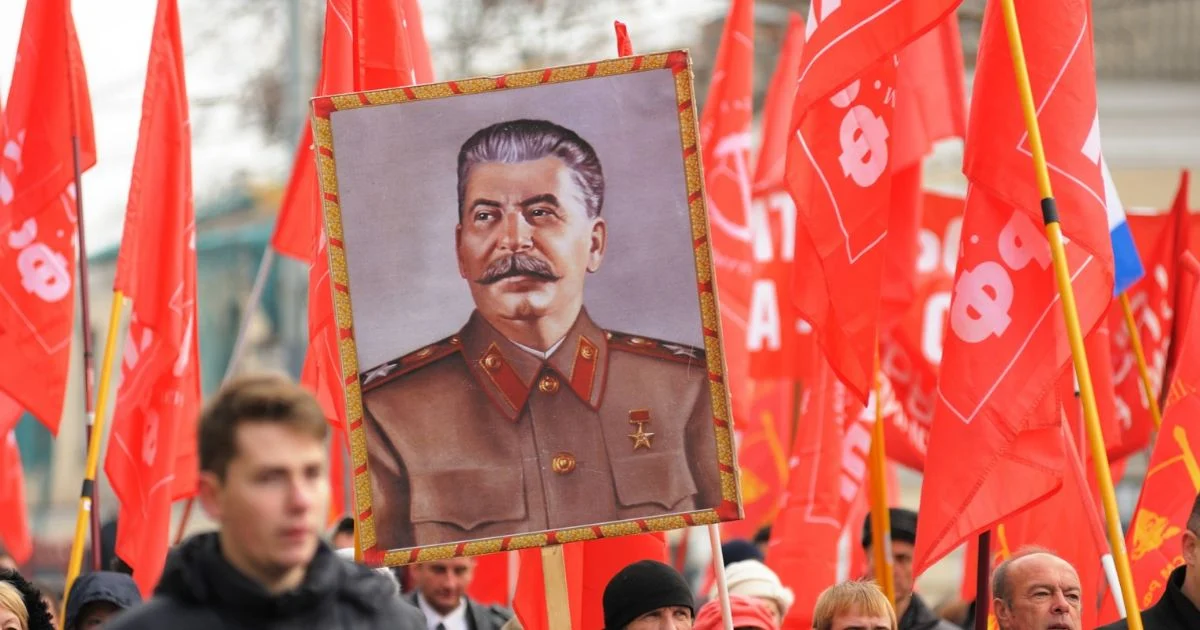
Joseph Stalin, the architect of the Soviet Union’s totalitarian state, and John Calvin, the influential theologian of the Protestant Reformation, represent two vastly different historical figures, yet a superficial glance at their respective worldviews might suggest a curious, unsettling parallel: both believed in a form of predestination, an understanding that history was moving towards an inevitable, predetermined conclusion. However, this initial resemblance quickly dissolves under scrutiny, revealing a profound chasm between two radically opposed conceptions of humanity, history, power, and the very nature of existence. The divergence between Calvin’s doctrine of divine election and Stalin’s Marxist-Leninist historical inevitability illuminates the critical distinction between a worldview rooted in transcendent authority and one that substitutes human will for divine oversight, ultimately leading to contrasting outcomes of spiritual assurance versus state-sponsored terror.
Calvin’s Divine Providence: Sovereignty, Humility, and Assurance
John Calvin, born Jean Cauvin in 1509 in Noyon, France, emerged as a pivotal figure in the 16th-century Protestant Reformation. His monumental work, Institutes of the Christian Religion, first published in 1536, systematized Reformed theology and became a cornerstone of Protestant thought. At the heart of Calvin’s theology lay the doctrine of divine sovereignty, asserting that God is absolutely supreme over all creation, that nothing ultimately escapes His providence, and that salvation rests upon divine election rather than human merit.
For Calvin, predestination was not a grim, abstract theory designed to inspire fear, but rather a profound expression of God’s absolute control over history and salvation. This conviction was intended to produce assurance in believers, knowing that their eternal destiny rested securely in God’s hands, not their own fallible efforts. It also cultivated deep humility, reminding individuals that their existence, talents, and salvation were gifts of divine grace. The world, in Calvin’s intricate understanding, was neither accidental nor autonomous. God did not simply create the universe and then abandon it to chance; rather, He continually governed His creation through His active providence.
This belief carried enormous practical significance for Reformed Christians. If God governs history, the believer is liberated from the crushing burden of having to control it. Wars might rage, governments might collapse, diseases might spread, and personal fortunes might disappear. Good people might suffer, and the wicked might prosper. Yet, none of these chaotic events meant that history had escaped God’s overarching control. As articulated in the Heidelberg Catechism, a foundational Reformed confession written shortly after Calvin’s Institutes, divine providence signifies that "all things" come to us not by mere chance, but through God’s loving and fatherly hand.
Crucially, this theological framework did not breed passivity. On the contrary, Calvin and subsequent generations of Reformed Christians were fiercely active in their societies. They were commanded to work diligently, pray fervently, raise children in faith, assist their neighbors, obey lawful authority, and actively oppose injustice. They established churches, schools, universities (like the Academy of Geneva), businesses, charities, and political institutions that profoundly shaped Western civilization. The Protestant work ethic, often associated with Calvinism, emphasized diligence and frugality as expressions of faith. However, the ultimate outcome of history, the grand sweep of events, did not depend on human effort. Their duty was to act faithfully within God’s plan, leaving the future to Him. This doctrine served as a powerful check on human ambition and the "sovereign ego," reminding even the most powerful rulers that they remained creatures, subject to a higher authority and an ultimate judgment they did not create. For Calvin, the profound truth was that "man does not become God."
Stalin’s Historical Materialism: The Party as Providence
In stark contrast, Joseph Stalin (born Ioseb Besarionis dze Jughashvili in 1878) inhabited an entirely different intellectual universe, forged in the crucible of early 20th-century Russian revolutionary fervor. Ascending to power in the Soviet Union after the death of Vladimir Lenin in 1924, Stalin became the unrivaled dictator until his death in 1953. His ideology, Marxism-Leninism, rejected the Christian understanding of Providence outright, replacing it with historical materialism. This doctrine, rooted in the philosophical ideas of Karl Marx and Friedrich Engels, posited that history moved according to discernible, impersonal economic laws, progressing through conflicts between economic classes towards an inevitable communist society. Capitalism, according to this theory, contained within itself the forces that would inevitably destroy it, leading to the triumph of the proletariat and the disappearance of class distinctions.
History, in this view, had a destination, but critically, no divine Author. This absence of a transcendent God created a profound ideological vacuum that Stalin and the Communist Party swiftly filled. If history’s promised future – the utopian communist society – did not arrive on schedule, or if obstacles appeared, then somebody had to "fix" it, to actively guide and accelerate the predetermined trajectory. Under Stalin, the Communist Party increasingly assumed this responsibility, becoming the sole interpreter of historical laws and the vanguard of the proletariat. And within the Party, Stalin increasingly centralized all responsibility and authority unto himself.
The result was an extraordinary and terrifying paradox. Marxism claimed that history was governed by impersonal forces, yet Stalin behaved as though the entire future of civilization depended upon his personal decisions, his unerring foresight, and his ruthless execution of the Party’s will. He became, in effect, a substitute for Providence. His decrees were not mere policy decisions but pronouncements intended to fulfill historical destiny.
The Era of Terror: Collectivization, Purges, and the Gulag
This ideological framework provided the justification for unprecedented state terror and human suffering. Stalin’s ambition to rapidly transform the agrarian Russian Empire into an industrial and military superpower led to devastating policies:
- Forced Collectivization of Agriculture (1928-1940): Aimed at eliminating private land ownership and creating collective farms, this policy was implemented with brutal force. Peasants, particularly the "kulaks" (prosperous peasants, often vaguely defined to include anyone resisting the policy), were dispossessed, exiled, imprisoned, or executed. The resulting disruption, famine, and state-induced starvation, most notably the Holodomor in Ukraine (1932-1933), led to the deaths of an estimated 3 to 7 million people.
- Rapid Industrialization (Five-Year Plans, beginning 1928): While achieving impressive industrial growth, these plans were fueled by immense human cost, including forced labor, poor working conditions, and suppression of dissent. Millions toiled and died in brutal conditions to meet unrealistic targets.
- The Great Purge (1936-1938): This period of intense political repression saw the systematic elimination of perceived enemies of the state. Old Bolsheviks, military leaders, intellectuals, ethnic minorities, and countless ordinary citizens were subjected to show trials, forced confessions, and summary executions. Estimates vary, but during this period alone, hundreds of thousands were executed, and millions more were sent to the Gulag.
- The Gulag System: A vast network of forced labor camps, the Gulag became the physical embodiment of Stalinist "justice" and a terrifying substitute for the Christian concept of hell. Here, "heretics" – those who deviated from Party orthodoxy, or simply those deemed politically unreliable – were imprisoned, tortured, and worked to death. Between 1930 and 1953, approximately 18 million people passed through the Gulag system, with an estimated 1.5 to 1.7 million dying there.
- Suppression of Religion: Churches were closed or destroyed, clergy persecuted, and religious practice severely curtailed in a systematic effort to eradicate "opium for the masses" and replace it with state atheism.
Millions of people were relocated, imprisoned, starved, or killed if they stood between the present and the "promised future" of communism. The Christian says: God governs history. The Stalinist effectively said: history has revealed its laws to the Party. And Stalin increasingly asserted: I speak for the Party. The distance between those propositions, while seemingly small in semantic form, represented an infinite divergence in human experience.
A Chasm of Understanding: God, Man, and Power
The comparison between Calvin and Stalin reveals several critical distinctions that underscore their radically opposed understandings of man, history, power, and God.

The Source of Authority: Divine Decree vs. Human Interpretation
For Calvin, ultimate authority resided in God and His revealed word, which stood above all human institutions, including the church and the state. Even the greatest king was subject to God’s law. For Stalin, with God abolished, authority shifted to the Party, and eventually, to himself as the authoritative interpreter of Marxism-Leninism and the Party’s will. Political disagreement under Stalin thus quickly morphed into something akin to theological heresy, punishable by death or imprisonment.
The Purpose of "Chosenness": Spiritual Assurance vs. Political Annihilation
Calvinism teaches election, requiring an Elector (God). This doctrine, properly understood, is an assertion of God’s power and a profound denial of human power, leading to humility and assurance. Stalinism, by eliminating God, paradoxically produced something resembling election without a divine Elector. Certain classes were "chosen" by history (the proletariat), while others (the bourgeoisie, kulaks) were condemned to oblivion. But since "history" has no mind to choose, judge, love, or condemn, someone had to interpret history’s supposed verdict. This responsibility fell to the Communist Party, and ultimately, to Stalin. This "election" became a justification for class warfare, purges, and the systematic elimination of entire social groups, rather than a source of spiritual comfort.
Confronting Chaos: Trust in God vs. Demand for Control
The difference between Calvin and Stalin becomes clearest when each confronts the uncertainty and chaos of history. Calvin could say: "God knows." This offered a psychological liberation, allowing believers to do their duty and trust in Providence, even when outcomes were unclear or unfavorable. It did not produce passivity but channeled human action towards righteous endeavors, leaving the ultimate future to God.
Stalin, by contrast, had no such luxury. If there was no God, and history nevertheless had a predetermined destination, then somebody had to ensure mankind reached it. The dictator became engineer, prophet, judge, and executioner. Failure became intolerable because it was not merely a political setback; it threatened the entire theory of historical inevitability. When collectivization produced catastrophe, the ideology could not be wrong; therefore, someone must have sabotaged it. When industrial targets were missed, the economic theory could not be defective; someone must have betrayed the revolution. When political opposition appeared, history itself was being obstructed. Enemies had to be discovered, confessions obtained, purges conducted, and people made to disappear. Terror became not just a technique for maintaining Stalin’s power but a logical, inescapable consequence of a political system that claimed absolute certainty about history while denying any authority beyond itself.
Human Nature: Depravity vs. Perfectibility
Calvinism’s doctrine of human depravity warns against entrusting unlimited power to human beings, recognizing that fallen nature exists in all, from prince to peasant. No political leader escapes this reality, necessitating checks and balances on power. Stalin’s worldview effectively reversed this proposition. Ordinary human beings could not be trusted to understand their own interests; they might cling to private property, religion, family loyalties, or political independence. Because the Party, and ultimately Stalin, understood history better, it had the right, even the duty, to re-educate, re-orient, and coerce the people. The servant of history became its self-appointed master.
The Human Cost: Freedom, Terror, and Legacy
The contrast ultimately involves two profoundly different understandings of history’s meaning. For Calvin, history has meaning because God exists outside history, creating time, governing it, and ultimately judging what occurs within it. For Stalin, history had to generate its own meaning, entirely from within its material processes. This made political power enormously important. If there is no transcendent Judge, the judgment of history becomes the highest conceivable tribunal. If there is no divine Providence, political action becomes the sole instrument through which history advances. And if mankind possesses knowledge of history’s inevitable destination, enormous cruelty can be justified as merely accelerating the inevitable.
The legacy of these two worldviews could not be more divergent. Calvinism, despite its occasional misinterpretations and historical abuses, ultimately fostered societies that valued individual conscience, limited government, education, and economic enterprise, all under the overarching belief in a benevolent, sovereign God. It provided comfort, assurance, and a framework for ethical action without demanding absolute control over outcomes.
Stalinism, by contrast, plunged vast populations into an abyss of fear, suspicion, and unimaginable suffering. The abolition of God meant the abolition of objective moral standards, allowing the state to become the ultimate arbiter of right and wrong, life and death. The "paradise" it promised never materialized; instead, it delivered tyranny, famine, and genocide on an industrial scale. The estimated death toll attributable to Stalin’s regime ranges from 20 to 60 million, a stark testament to the consequences of a political system that attempts to seize divine prerogatives.
Conclusion: The Enduring Lesson of Providence vs. Ideology
Placing Calvin and Stalin side by side creates an important and sobering contrast. Both confronted the ancient human question of whether history has meaning and direction. Calvin answered that it does, because history belongs to God. Stalin answered that it does, because history operates according to material laws discoverable and manipulable by man.
From these fundamentally different starting points came dramatically different conclusions and human experiences. Calvin’s believer could look upon a chaotic world and say: "I do not understand what God is doing, but I will do my duty and trust in Providence." Stalin, conversely, could look upon a chaotic world and conclude that chaos demonstrated the necessity for greater, absolute control.
One worldview provides the comfort of confidence grounded in a transcendent order; the other demands the insecurity of constant management and ruthless enforcement. One places the ultimate outcome beyond man’s control, fostering humility and accountability; the other tempts man to seize control of the outcome, unleashing unchecked power. And therein lies perhaps the greatest difference between Providence and ideology. The doctrine of Providence tells humanity that history has a Master, and that we are not Him. Stalinism abolished the Master but retained the plan. Eventually, someone had to take His chair. Stalin volunteered, with catastrophic consequences that continue to echo through history, serving as a grim warning against the dangers of human hubris when it attempts to usurp divine authority.









