In the highly competitive world of professional barrel racing, the lineage of a horse often takes center stage, with pedigrees meticulously scrutinized in results, championship stories, and discussions of record-breaking performances. The names of legendary sires and dams are frequently cited, replicated in breeding programs, and compared to other equine greats whose genetic blueprints promise speed, agility, and a winning temperament. However, a remarkable category of equine athletes, known as "grade horses," consistently challenges this pedigree-centric narrative. These horses, lacking formal registration papers from established breed associations, have nevertheless defied expectations, stopped the clock with astonishing precision, and carved out illustrious careers, proving that heart and talent can transcend documented bloodlines. Their stories are a testament to the fact that true greatness in the arena is not always determined by a piece of paper.
The Significance of Pedigree in Equestrian Sports
For decades, the American Quarter Horse has been the dominant breed in Western performance disciplines, particularly barrel racing, owing to its explosive speed, powerful hindquarters, and innate cow sense. Breed associations like the American Quarter Horse Association (AQHA) maintain extensive registries, documenting the lineage of horses for generations. This documentation is crucial for breeders, buyers, and competitors alike, as a strong pedigree can indicate desirable traits, predict athletic potential, and significantly increase a horse’s market value. Bloodlines boasting champions like Dash For Cash, Frenchmans Guy, or Fire Water Flit are highly sought after, with offspring commanding premium prices and entering the competitive arena with heightened expectations. The belief is that genetics provide a significant advantage, predisposing horses to excel in the specific demands of barrel racing – bursts of speed, quick turns around three barrels, and the mental fortitude to perform under pressure. Therefore, when a "grade horse" achieves national or even international acclaim, it represents a profound disruption of conventional wisdom, highlighting an extraordinary individual spirit.
Pecan: Molly Powell’s Undocumented Champion

Among the most compelling narratives of grade horse success is that of Pecan, the phenomenal mare ridden by celebrated barrel racer Molly Powell. Powell herself is a titan in the sport, boasting an impressive resume that includes a College National Championship title, ten qualifications for the prestigious National Finals Rodeo (NFR), an NFR championship, two reserve world championships, and even a gold medal at the 2002 Olympics. Her career is marked by an unwavering ability to pilot exceptional horses to victory, yet it was Pecan, a mare without official papers, who perhaps best embodied the spirit of relentless "try."
Pecan’s origins, while not formally documented, possess an intriguing history. Born in 1988, she was bred by Powell’s parents, a product of their grade childhood horse, Brownie, and a retired racehorse stallion named Bumpy. Brownie, a mare, was believed to have originated from the Pagan Indian reservation in Alberta, allegedly a cross between a Welsh pony and a King Leo Bar-bred mare named Kilo Bar. Bumpy, the sire, carried the distinguished Thoroughbred bloodlines of In Reality and Intentionally. This informal, yet diverse, genetic tapestry hinted at athleticism, combining the agility and toughness of a pony with the speed of a racehorse, even if it wasn’t recognized by a breed registry.
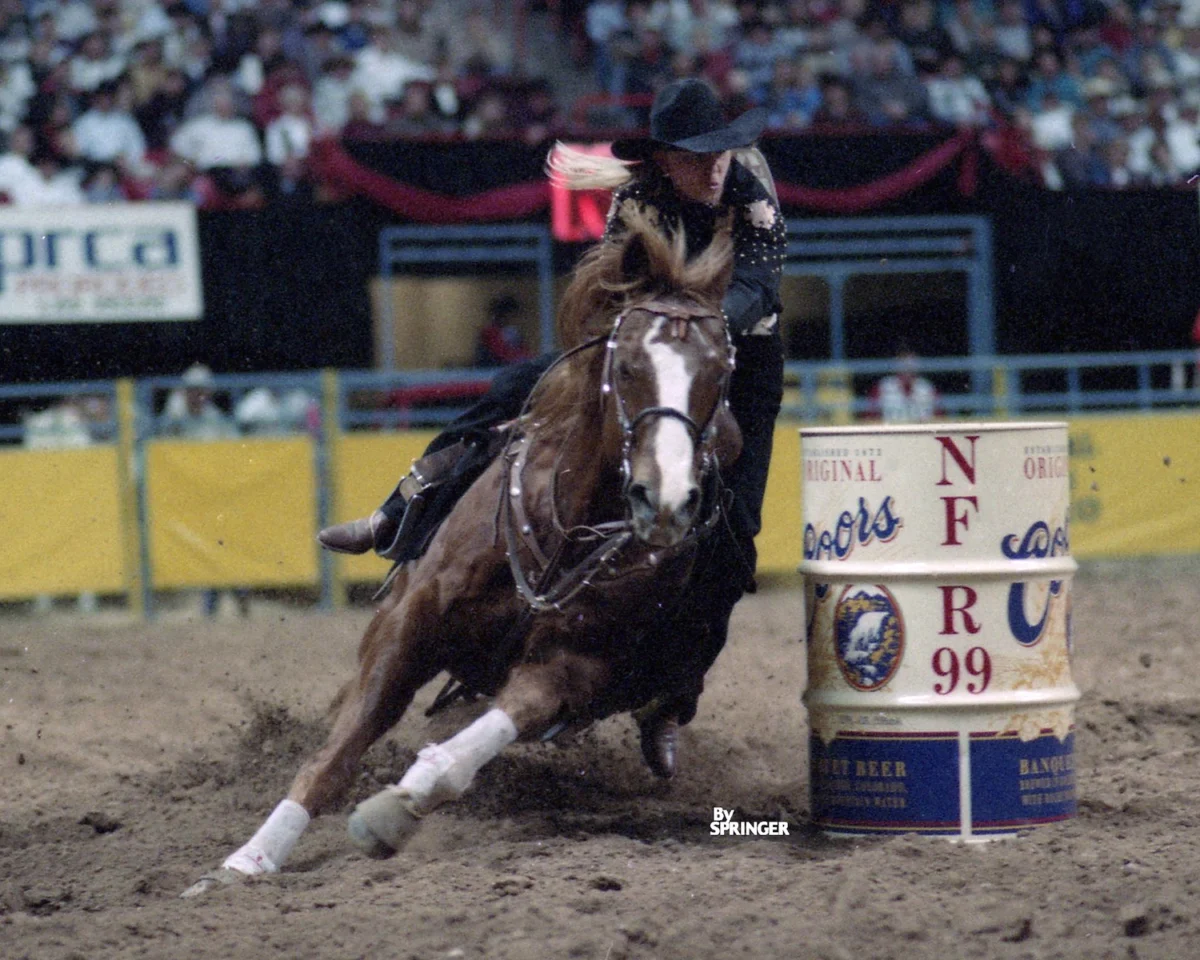
Molly Powell undertook Pecan’s training, and their competitive journey began when Pecan was just three years old and Powell fifteen. The mare quickly demonstrated her remarkable talent, clocking competitive times and consistently placing in open races. Their partnership rapidly evolved, leading to significant milestones. In 1994, while Powell was attending Vernon College in Texas, the duo finished a respectable 20th in the Women’s Professional Rodeo Association (WPRA) world standings, a remarkable achievement for any horse, let alone an unregistered one. The following year, 1995, proved to be a breakout season. Powell and Pecan not only clinched the College National Finals Rodeo championship but also triumphed at the Original Coors Showdown and secured their inaugural qualification for the National Finals Rodeo. This was no fluke; the pair would go on to qualify for four consecutive NFRs from 1995 to 1998, competing against the nation’s elite barrel racing horses, many with impeccable pedigrees.
Pecan’s illustrious career, unfortunately, was cut short in 1999 at the age of 11 due to a severe infection following an injection to her coffin joint. She was honorably retired, living out her remaining years as a broodmare in Powell’s pasture, a cherished member of the family, until her passing in 2021. Her legacy remains indelible, a powerful reminder that exceptional talent and an indomitable spirit can emerge from the most unexpected backgrounds, fundamentally challenging the notion that bloodlines are a limiting factor in barrel racing success.
Buddy Rose: From Sale Barn Underdog to Rodeo Star

Another captivating story of an unregistered champion is that of Buddy Rose, a grade gelding whose journey from obscurity to the upper echelons of professional rodeo exemplifies resilience and raw talent. His story, initially documented by Blanche Schaefer for Barrel Horse News, is a testament to the belief that the "perfect ingredients" for a winning horse aren’t always found in carefully curated pedigrees.
Buddy Rose’s beginnings were humble, to say the least. As a two-year-old, he was discovered in a horse sale barn in Mississippi, an unassuming prospect among many. Katelyn Albritton, a talented young trainer, recognized a spark in him and purchased him for a mere $200, intending to use him as a lesson horse. Albritton’s adept training quickly revealed Buddy’s potential, far surpassing that of an average lesson horse. However, Buddy also possessed a deeply sensitive and wary nature. Destri Devenport, a multiple National Barrel Horse Association (NBHA) 1D champion who would later form an unbreakable bond with Buddy, noted his initial timidity: "He’s real watchy on the ground and pretty scared of everybody and everything—there’s some days people can’t even catch him in his stall." His early life before Albritton’s care remains a "grey area," adding to the mystique of his incredible ascent.
As Buddy Rose’s talent became undeniable, he transitioned to the ownership of the Chouest family of Galliano, Louisiana. It was through her work for the Chouests that Devenport first encountered Buddy, and their connection was almost instantaneous. Allie Chouest, the family’s daughter, found Buddy slightly too small for her 5’11" frame, opening the door for Devenport to ride him.
The true depth of their partnership became evident in 2015 during RFD-TV’s The American Semifinals. Devenport, Allie, Allie’s brother Max, and their trainer all qualified, each riding capable horses. Yet, it was Devenport and Buddy Rose, initially considered "the weakest link" among the Chouest family’s mounts, who advanced to the prestigious performances at AT&T Stadium. Devenport recounts the profound impact of this achievement: "Out of all of us, I was the only one who qualified to the performances and AT&T Stadium, and I did it on him. There were so many incredible horses… it’s one of the toughest there is… not to mention all the rodeo horses." This pivotal moment solidified their unique bond, with Devenport observing, "There’s something about him and I, there’s a connection there, and he’s showcased a lot of himself and shown more confidence through me the last two years I’ve had the opportunity to ride him."
In 2019, Devenport officially purchased Buddy Rose, cementing their future together. Despite a late start to the rodeo season, hitting the road only in June, their partnership flourished. By the close of the 2019 rodeo season on September 30, Devenport and Buddy Rose had amassed an impressive $51,565 in earnings, securing a commendable 28th place in the WPRA world standings. This financial success and high ranking against horses with multi-million dollar pedigrees underscore Buddy Rose’s exceptional capabilities.

Devenport consistently emphasizes that Buddy Rose’s greatest asset isn’t his speed or agility alone, but his sheer mental fortitude and "toughness." Despite his quirky and timid nature outside the arena – "he’s afraid of everything, you can’t throw splint boots down in front of him, it scares him to death" – he undergoes a profound transformation when pointed towards the barrels. "When you point him toward the barrels or get ready to go down the alley, he is a completely different animal and gets so excited to run—it’s where he feels most confident." This unwavering commitment, she believes, is an intrinsic quality that cannot be manufactured. Devenport, coming from a family of accomplished horsemen who often worked with "underdog" types, champions the overlooked prospects. She states, "I think a lot of really good horses are overlooked because of that [emphasis on pedigree]… you can take a horse like Buddy Rose that has no papers and no idea where he’s come from… and the plain sorrel with no papers will be overlooked because it’s bred for nothing even though it may be a lot better horse than the one bred as perfect as you can get." For Devenport, Buddy Rose is more than just a partner; he is a best friend who has made dreams come true, proving unequivocally that an undocumented past does not limit a future of unparalleled success.
Mr. Wonderful: A Dual-Purpose NFR Contender
The narrative of grade horses finding their way to the pinnacle of barrel racing also includes Mr. Wonderful, a grade gelding who carried two members of the Myllymaki family to the National Finals Rodeo. Rachael Myllymaki stands as a prominent figure in youth rodeo history, notably becoming the youngest barrel racer ever to qualify for and compete at the NFR at the tender age of 11 in 1988. Her career spanned seven NFR qualifications (1988, 1990, 1994, 1999-2002), demonstrating remarkable longevity and consistency. Adding to the family’s rodeo heritage, her mother, Judy Myllymaki, also qualified for the NFR in 1998.
What makes Mr. Wonderful’s story particularly compelling is that he served as the mount for both Rachael and Judy during their late 1990s NFR qualifications. This dual success highlights not only his individual talent but also his versatility and adaptability to different riders at the highest level of competition. In 1994, Rachael Myllymaki and Mr. Wonderful achieved a significant victory, winning Round Three of the NFR with an impressive time of 14.10 seconds. This round win, against the fastest barrel horses and riders in the world, solidified Mr. Wonderful’s status as a legitimate contender, irrespective of his lack of official papers. The fact that a single grade horse could consistently perform at this elite level, helping both mother and daughter achieve their NFR dreams, underscores the profound impact an individual horse’s character and ability can have. Mr. Wonderful’s accomplishments speak volumes about the quality that can be found beyond the breed registries, proving that some horses are simply born with an innate "wonderful" ability to compete and win.
Broader Impact and Implications: Redefining Value Beyond Pedigree

The collective stories of Pecan, Buddy Rose, and Mr. Wonderful offer a powerful counter-narrative to the prevailing emphasis on pedigree in barrel racing and indeed, in many equestrian disciplines. These horses are not isolated anomalies; rather, they represent a significant truth: while genetics undoubtedly play a role in athletic potential, the intangible qualities of "heart," "try," mental toughness, and the bond with a rider can often be the deciding factors in achieving extraordinary success.
The implications of these grade horse champions are far-reaching. Firstly, they challenge breeders and buyers to look beyond the printed page of a pedigree. While a strong lineage provides a statistical advantage and a degree of predictability, these stories underscore the importance of evaluating individual horses based on their conformation, movement, temperament, and, most importantly, their intrinsic desire to perform. This encourages a more holistic approach to scouting and selection, potentially opening doors for talented but unregistered horses who might otherwise be overlooked.
Secondly, these narratives inspire aspiring barrel racers, particularly those with limited budgets, to believe that top-tier success is not exclusively reserved for those who can afford impeccably bred and highly expensive horses. Buddy Rose’s $200 purchase price and subsequent rise to an NFR-level contender offer a beacon of hope, demonstrating that a diamond in the rough can indeed be found. This democratizes the sport to some extent, emphasizing that dedication, skillful training, and a profound connection between horse and rider are paramount.
Thirdly, these horses contribute to a richer, more diverse tapestry of equine excellence. They remind the equestrian community that greatness can spring from unexpected places, from unrecorded crossings, or from horses whose early lives remain a mystery. This fosters an appreciation for the individual spirit and unique qualities of each horse, regardless of their background. It highlights that the "perfect ingredients" for an upper-level winning horse are not solely confined to a genetic code but are often a complex interplay of natural ability, exceptional training, and an unwavering will to win.
In conclusion, the legendary careers of Pecan, Buddy Rose, and Mr. Wonderful serve as powerful testaments to the unyielding spirit of grade horses. They have not only shattered stereotypes but have also etched their names into the annals of barrel racing history, proving unequivocally that a horse’s worth and potential are not defined by a set of registration papers. Their accomplishments underscore a fundamental truth in equestrian sports: while pedigree may open doors, it is character, courage, and an undeniable will to excel that ultimately lead to true, enduring championship glory in the arena.