As the world’s elite equestrians descend upon Paris for the 2024 Summer Olympics, the discipline of eventing stands as a testament to the sport’s profound evolution from a grueling military evaluation to a refined display of athletic precision. Known as the "equestrian triathlon," eventing combines the grace of dressage, the stamina of cross-country, and the technical skill of show jumping. While the core components remain, the modern iteration of the sport is a world away from its debut at the 1912 Stockholm Games, reflecting over a century of changes in horse welfare, gender inclusivity, and technical standards.
The Genesis of the Military Test
Olympic eventing first made its appearance during the 1912 Summer Games in Stockholm, Sweden. At its inception, the competition was known simply as "The Military." This title reflected the event’s primary purpose: to test the suitability of officers’ chargers for the rigors of cavalry service. Because the competition was designed as a surrogate for wartime conditions, participation was strictly limited to active-duty military servicemen and army-owned horses.
In that inaugural event, 27 riders representing seven nations took to the field. The participating countries included Denmark, Germany, Sweden, France, Belgium, Great Britain, and the United States. The team structure of 1912 stipulated a full squad of four riders per nation. Six of the seven participating countries met this requirement, while Denmark fielded a smaller contingent of only three riders. This early diversity of participation laid the groundwork for what would become one of the most prestigious international equestrian competitions.

A Five-Day Trial of Endurance
The structure of the 1912 competition would be unrecognizable to modern spectators. Today, eventing is typically held over three days, beginning with dressage, followed by cross-country, and concluding with show jumping. In 1912, however, the event was a five-day odyssey that emphasized raw endurance over the technical finesse prized today.
Day one of the 1912 Stockholm Games featured an "Endurance Test" of staggering proportions. Horses and riders were required to complete a 50-kilometer (approximately 31-mile) road ride, which was immediately followed by a 5-kilometer cross-country course. To put this in perspective, the 2024 Paris Olympic cross-country course is set at 5,300 meters (5.3 kilometers) with an optimum time of 9 minutes and 18 seconds. In 1912, the total distance covered on the first day alone—55,000 meters—was more than ten times the length of the modern cross-country phase.
The toll of this first day was significant. Despite the course being marked by red flags to guide the riders, three competitors were eliminated for going off course, and one was disqualified for exceeding the time limit, which was set at four hours for the endurance phase and 15 minutes for the cross-country segment. By the end of the first day, only 22 of the original 27 starters remained in the competition, representing an elimination rate of approximately 19 percent.
The Speed and Weight Requirements
Following a much-needed rest on day two, the competition resumed on day three with a "Speed Test." This phase consisted of a 3,500-meter steeplechase course featuring ten plain obstacles. Horses were required to maintain a speed of 600 meters per minute.

A defining characteristic of the 1912 Games was the strict adherence to military realism, which included a minimum weight requirement. Horses were required to carry at least 80 kilograms (approximately 176 pounds) during the jumping phases. This meant that if a rider weighed 74 kilograms, an additional 6 kilograms of lead or equipment had to be added to the saddle to meet the regulation. This rule was intended to simulate a soldier carrying a full field kit into battle.
The steeplechase phase claimed more casualties. Two riders retired after losing their way on the course, and Great Britain’s Lieutenant Lawrence suffered a fall that resulted in a concussion. Although he recovered shortly thereafter, he was unable to continue. By the conclusion of the speed test, the field had narrowed to 19 horse-and-rider pairs.
Technical Shifts in Jumping and Dressage
The final two days of the 1912 competition focused on precision. Day four featured "Prize Jumping," the precursor to modern show jumping. The 1912 course consisted of 15 obstacles with a maximum height of 1.3 meters and a staggering width of 3 meters.
Comparing these specifications to the 2024 Paris Games reveals a shift in philosophy. Modern jumps in Paris are set at a maximum height of 1.25 meters, which is slightly lower than the 1912 standard. However, the most dramatic difference lies in the width, or "spread," of the obstacles. Modern Olympic jumps have a maximum spread of 1.45 meters—less than half the 3-meter width allowed in 1912. This change reflects a move away from testing a horse’s ability to clear wide trenches toward testing their ability to navigate complex, technical lines and related distances.

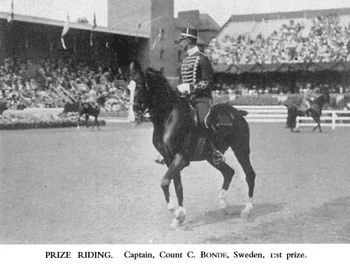
Interestingly, dressage—which now opens the competition to ensure horses are calm and obedient before the high-energy phases—was the final test in 1912. Known then as "Prize Riding," the test occurred on day five. The requirements were starkly different from modern dressage. Riders entered the arena at a gallop and were given ten minutes to demonstrate the walk, trot, and gallop at both "collected" and "fast" speeds. Extra points were awarded for advanced movements like the Spanish walk, piaffe, and passage, or for riding with a single hand on the reins. Unlike modern eventing dressage, the 1912 test did not require figure-eights or flying changes, as those were considered separate from the jumping and obedience requirements of a military horse.
From Stockholm to Paris: A Century of Evolution
The results of the 1912 Games saw the host nation, Sweden, claim the team gold medal, led by Lieutenant Axel Nordlander, who also secured the individual gold. Germany took the silver, and the United States earned the bronze.
Since that time, the sport has undergone several "sea changes." The most significant occurred in 1952, when the Olympic equestrian disciplines were finally opened to civilians and women. Prior to this, the "Military" roots kept the sport exclusive to the officer corps. Today, eventing is one of the few Olympic sports where men and women compete directly against one another on equal terms.
Another major shift occurred in 2004, when the "Long Format"—which included the roads and tracks and steeplechase phases—was abolished in favor of the "Short Format." This change was driven by horse welfare concerns and the logistical difficulty of finding venues large enough to accommodate the massive endurance phases. The removal of the steeplechase shifted the focus of the sport toward the technicality of the cross-country phase and the precision of dressage.

Implications for the 2024 Paris Games
As the 2024 Games unfold at the historic Palace of Versailles, the venue itself serves as a bridge between the sport’s aristocratic past and its modern professional status. The 2024 cross-country course, while shorter than the 1912 endurance test, is infinitely more complex. Modern course designers use terrain, "skinny" fences, and angled brushes to test the communication between horse and rider, rather than just their ability to survive a 55-kilometer trek.
The shift in jumping dimensions also highlights the increased athleticism of the modern sport horse. While the 1912 horse was an endurance machine capable of carrying heavy weights over massive distances, the 2024 event horse is a specialized athlete, bred for a combination of "blood" (speed and stamina) and "scope" (jumping ability).
Conclusion
The transformation of Olympic eventing from the 1912 "Military" to the 2024 Paris Games illustrates the broader evolution of equestrian sport. By prioritizing horse welfare and technical skill over raw military utility, the sport has preserved its heritage while adapting to 21st-century values. While the riders of 1912 might be shocked by the lack of a 50-kilometer road ride, they would undoubtedly recognize the enduring bond between horse and rider that remains the heartbeat of the competition. As the world watches the results from Paris, the legacy of those 27 original riders in Stockholm continues to influence every stride taken on the cross-country course.