The necessity of field shelters for horses has long been a subject of debate among equestrian professionals, veterinarians, and hobbyist owners. While the provision of stabling is a standard practice in many regions, the specific requirements for horses kept on summer pastures—particularly regarding shade, protection from wind and rain, and relief from biting insects—have remained under-researched. To address this gap in animal welfare science, a team of four prominent researchers from the Swedish University of Agricultural Sciences (SLU) in Uppsala conducted a comprehensive study to determine how horses interact with various shelter designs. Researchers Kristina Dahlborn, Elke Hartmann, Richard Hopkins, and Claudia von Brömssen initiated the project after observing that current welfare guidelines often overlook the nuances of summer pasture management, focusing instead on winter protection.
The study aimed to provide a data-driven foundation for future welfare recommendations. By analyzing the behavior of horses in controlled environments with access to different structural configurations, the researchers sought to identify which features—such as roofing or wall placement—are most critical from the horse’s perspective. This research is particularly timely as global temperatures rise and the prevalence of insect-borne stressors increases, making the "run-in" shelter an essential component of modern equine husbandry.
Experimental Design and Methodological Rigor
To isolate the variables that influence a horse’s decision to seek shelter, the research team designed three distinct experimental structures. Each shelter was constructed as a square, measuring 13 feet by 13 feet (4 meters by 4 meters), providing an area of 169 square feet (16 square meters) per unit. This size is consistent with standard individual turnout shelters used in professional equestrian facilities.

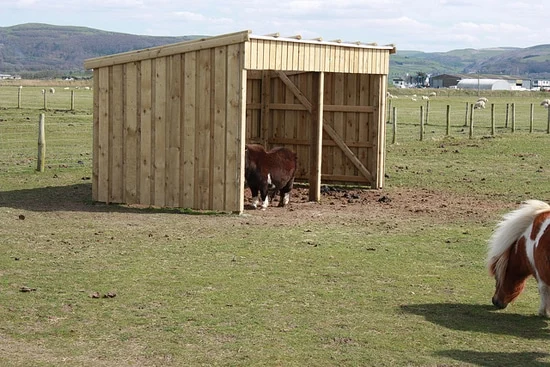
The three configurations were labeled Shelter A, Shelter B, and Shelter C. Shelter A represented the most comprehensive protection, featuring a solid roof and three fully enclosed sides. Shelter B also included a roof, but its rear wall was only partially closed, with the upper half sealed to allow for airflow while still providing a windbreak. Shelter C was designed to test the specific value of overhead cover; it featured four walls but no roof. By offering these variations, the researchers could determine whether horses prioritize shade and rain protection (the roof) or wind protection and a sense of enclosure (the walls).
The subjects of the study were eight Warmblood horses. In the context of equine science, "Warmbloods" refers to a category of middle-weight horse breeds primarily of European origin. These horses are distinct from "cold bloods" (heavy draft horses) and "hot bloods" (refined breeds like the Arabian or Thoroughbred). Warmbloods are specifically bred for equestrian sports, such as dressage and show jumping, and are characterized by an open studbook policy and rigorous selection processes. Because of their physical size and metabolic rates, Warmbloods provide an excellent baseline for studying how modern sport horses react to environmental stressors.
The Chronology of the Experiment
The experiment was conducted over a series of 24-hour cycles. Each of the eight horses was tested individually for a total of 48 hours in the test paddocks. To ensure the validity of the results, the horses were given a period of acclimatization to become familiar with the paddocks and the shelter structures before the formal data collection began. During the test periods, no other sources of shade, such as trees or hedgerows, were available, forcing the horses to choose between the provided structures or remaining in the open.
The horses were placed in turnout paddocks with access to two shelters at a time: either a choice between A and B, or a choice between A and C. This "forced choice" model allowed researchers to rank the structures based on the horses’ preferences.

Data collection was rigorous and continuous. Researchers utilized "scan sampling," a method where the horses’ behaviors and positions were recorded at five-minute intervals throughout the daytime. This resulted in 12 observations per hour. Over a 14-hour daytime period, the researchers recorded 168 individual data points for each horse, totaling thousands of observations over the course of the study. Specifically, the team looked for "insect defensive behaviors," which include tail swishing, skin twitching, head tossing, and stamping, to measure the level of environmental stress the horses were experiencing.
Key Findings: The Primacy of the Roof
The results of the study provided clear evidence that horses have a strong preference for overhead protection. Seven of the eight horses actively utilized the shelters, spending approximately 35.4% of the daytime hours inside. Conversely, this means the horses remained in the open for 64.6% of the daytime, likely for grazing or social monitoring, but sought the shelters during peak periods of heat or insect activity.
When presented with the choice between Shelter A (three sides and a roof) and Shelter B (partially open rear wall and a roof), the horses utilized both frequently. However, the preference shifted dramatically when Shelter C (walls but no roof) was introduced. Shelter C was rarely visited, even when Shelter A was available as an alternative. This suggests that from an equine perspective, a shelter without a roof does not qualify as an adequate refuge, regardless of the protection provided by the walls.
Interestingly, the researchers found that the duration of shelter use did not fluctuate significantly between day and night. The horses spent an average of 100.8 minutes inside the roofed shelters during the day and 105.8 minutes during the night—a negligible difference of only five minutes. The fact that horses used the shelters just as much at night, when the sun was not a factor, led the researchers to investigate other motivations for seeking cover.

The Impact of Insects and the Security Hypothesis
One of the most significant correlations identified in the study was the relationship between shelter use and insect defense. The probability—the measure of the likeliness that an event will occur—of a horse performing defensive behaviors like tail swishing was at its lowest when the horses were inside Shelter A.
Insects are more than a mere nuisance; they can cause significant stress, lead to skin infections, and interrupt grazing patterns. The researchers noted that in free-ranging conditions, horses often seek out "refuges" during peak insect activity. This often involves moving to higher ground where wind velocity is higher, as many biting flies are poor fliers in strong breezes. In a paddock setting, a three-sided shelter acts as a physical barrier and creates a micro-climate that is less attractive to certain insect species.
Furthermore, the high rate of nighttime shelter use prompted the researchers to formulate a "security seeking hypothesis." A hypothesis is a proposed explanation for a phenomenon that can be tested through further investigation. Because the horses were observed lying down almost exclusively inside the shelters during the cold season and at night, the researchers suggested that the structures provide a sense of safety. For a prey animal like the horse, having a protected space where they can achieve deep REM sleep (which requires lying down) is vital for long-term health and cognitive function.
Implications for Horse Owners and Welfare Policy
The findings from the Swedish University of Agricultural Sciences have broad implications for the equine industry. The study underscores that a field shelter is not merely a "luxury" for winter but a year-round necessity for optimal welfare.

For horse owners and stable managers, the data suggests that the design of a shelter is just as important as its presence. A simple roofed structure with at least one or two solid walls to block wind and insects is far more effective than a roofless pen. The study also highlights the importance of considering the individual horse’s background; horses that are accustomed to being stabled may have a higher psychological drive to seek the security of a "stall-like" environment even when turned out.
The researchers concluded that while this study provides a strong foundation, further investigation is needed. Future studies should examine whether horses kept in groups show the same preference patterns as those kept individually. In a group dynamic, social hierarchy often dictates access to resources, and a single small shelter may become a point of conflict rather than a place of refuge.
As the equestrian community moves toward more science-based management practices, studies like this one from Uppsala are essential. They move the conversation away from anecdotal "stable talk" and toward a professional, factual understanding of what horses actually need to thrive. For the budding equine scientist or the dedicated horse owner, these observations offer a new lens through which to view the daily behaviors of their animals, ensuring that the "sanctuary of the paddock" is truly serving its purpose.