Nashville, Tennessee – John Anderson, the revered country music legend whose unmistakable voice and signature honky-tonk sound captivated generations, passed away peacefully on Wednesday at his home in Smithville, Tennessee. He was 71 years old, just seven weeks shy of his 72nd birthday. The news of his death has sent ripples of sorrow throughout the country music community and among countless fans worldwide, prompting an immediate outpouring of tributes celebrating his profound impact on the genre.
Anderson’s publicist, Don Murry Grubbs, confirmed that the iconic singer died in his sleep, bringing to a close a remarkable career spanning several decades. His passing marks the loss of a truly unique artist, one who consistently championed traditional country values while pushing stylistic boundaries, forging a path that influenced countless musicians who followed.
The Anderson family released a poignant statement acknowledging the dual nature of their loss: "It is with the heaviest of hearts that we share the passing of our beloved husband, father, grandfather, and best friend. To the world, he was a gifted country music singer whose voice and songs touched countless lives. To us, he was so much more. He was the heart of our family, the one who made us laugh, loved us fiercely, and made every ordinary moment feel special. We are completely heartbroken. His music will live on, but for us, his greatest legacy will always be the love he gave his family and the memories we will carry with us forever. Please keep our family in your thoughts and prayers as we grieve this unimaginable loss." This heartfelt message underscored the deep personal void left by a man whose public persona as a music star was matched by his devotion as a family patriarch.
A Journey from Florida to Nashville Stardom
Born John David Anderson on December 13, 1954, in Apopka, Florida, his roots were deeply embedded in the American South. From an early age, Anderson was drawn to music, developing a passion that would eventually lead him to the heart of country music: Nashville. He moved to Music City in the early 1970s, a period often characterized by the evolving sounds of country music, moving from traditional honky-tonk to the more polished Nashville Sound. Anderson, however, would always retain a strong connection to the genre’s roots, a trait that would define his enduring appeal.
Before achieving widespread fame, Anderson toiled in various capacities, embodying the quintessential Nashville story of aspiration and hard work. Remarkably, his journey included a stint as a construction worker, a role that saw him contribute to the very foundation of country music history. He was part of the crew that helped build the Grand Ole Opry’s current home, which opened its doors in 1974. This unique connection to the hallowed venue—first as a laborer, then as a frequent performer—highlights a compelling full-circle narrative in his career, symbolizing his deep, hands-on connection to the genre he would come to define. He honed his craft by playing in local clubs and bars, developing the distinctive vocal style and stage presence that would soon become his trademark.
The Voice That Defined an Era: Chart Success and Signature Sound
Anderson’s breakthrough came in the early 1980s, an era when country music was embracing a new wave of artists who blended traditional elements with contemporary sensibilities. His distinctive baritone, characterized by a smooth yet powerful delivery and an unmistakable vibrato, immediately set him apart. His sound was a refreshing blend of honky-tonk twang, rockabilly energy, and heartfelt balladry, appealing to both purists and those seeking a fresh take on country music.
Throughout his decades-long career, John Anderson amassed an impressive catalog of hits, solidifying his status as a formidable force on the country charts. He earned 20 Top 10 hits on the Billboard country music charts, a testament to his consistent appeal and songwriting prowess. Among these, five tracks soared to the coveted No. 1 position, becoming anthems for country music lovers: "Wild and Blue" (1982), "Swingin’" (1983), "Black Sheep" (1983), "Straight Tequila Night" (1992), and "Money in the Bank" (1993).

"Swingin’," in particular, became one of his most iconic songs, earning him a Grammy nomination for Best Male Country Vocal Performance and becoming a crossover hit. Its playful lyrics and infectious melody showcased his versatility and charisma, endearing him to an even broader audience. The song’s enduring popularity is a testament to its timeless appeal, regularly appearing on lists of classic country tracks.
His early 1980s success with "Wild and Blue" and "Black Sheep" established him as a consistent hitmaker. However, after a brief period of fluctuating commercial performance in the late 1980s, Anderson experienced a remarkable resurgence in the early 1990s. This comeback was spearheaded by the album Seminole Wind (1992), a critically acclaimed and commercially successful project that yielded the No. 1 hit "Straight Tequila Night." This album and its subsequent hits, including "Money in the Bank," reaffirmed his relevance and artistry, demonstrating his ability to adapt and connect with new audiences while staying true to his core sound. Seminole Wind itself became one of his most celebrated albums, eventually being certified Platinum by the RIAA, signifying sales of over a million copies, a significant achievement in country music.
Beyond his chart-toppers, Anderson’s discography is rich with beloved songs that have become staples of country radio and fan favorites. These include the melancholic "Your Lying Blue Eyes," the nostalgic "1959," the introspective "I’m Just an Old Chunk of Coal" (a philosophical ode to self-worth), the quirky "Chicken Truck," the reflective "I Just Came Home to Count the Memories," and the tender "Would You Catch a Falling Star." Each of these songs, whether a rollicking honky-tonk number or a poignant ballad, showcased his storytelling ability and the emotional depth of his vocal delivery. His music often painted vivid pictures of rural life, love, loss, and resilience, resonating deeply with listeners who saw their own experiences reflected in his lyrics.
Accolades and Enduring Recognition
John Anderson’s contributions to country music were not only recognized by his legions of fans and commercial success but also by prestigious industry awards and honors. In 1993, at the height of his early 90s resurgence, he was bestowed with the Academy of Country Music (ACM) Career Achievement Award. This esteemed recognition celebrated his consistent artistic excellence, his significant chart history, and his lasting impact on the genre. It acknowledged a career defined by authenticity and a steadfast commitment to his unique musical vision.
Further cementing his place in country music history, Anderson was inducted into the Nashville Songwriters Hall of Fame in 2014. This induction honored his exceptional songwriting talents, recognizing him not just as a captivating vocalist but also as a craftsman of lyrics and melodies that have become integral to the country music canon. His ability to pen memorable tunes, often infused with wit, charm, and profound emotion, made him a true dual threat in Nashville.
These accolades underscore his multifaceted talent and the respect he commanded from peers and critics alike. His distinctive vocal style, often imitated but never truly replicated, combined with his knack for selecting and crafting compelling songs, ensured his enduring legacy long after his chart dominance.
An Outpouring of Tributes from Peers and Admirers
The news of John Anderson’s passing immediately triggered an outpouring of grief and heartfelt tributes from across the country music landscape. Artists, friends, and admirers took to social media and issued statements, sharing personal anecdotes and reflecting on his profound influence. The collective sentiment highlighted not only his musical genius but also his character as a humble, kind, and deeply respected individual.
T. Graham Brown articulated the rarity of Anderson’s talent: "I love artists that are identifiable the moment you hear them. It’s a rare gift, and John was a perfect example. I became an instant fan before we moved to town. In his case, it’s no cliché to say that he was truly one of a kind. I’m so proud to have worked with him on the road and become friends. His passing leaves a gaping hole in originality. May God bless his family in this hour of sadness. We’ll all miss you, brother." Brown’s words emphasize Anderson’s singular vocal identity, a quality that is highly prized in the music industry.

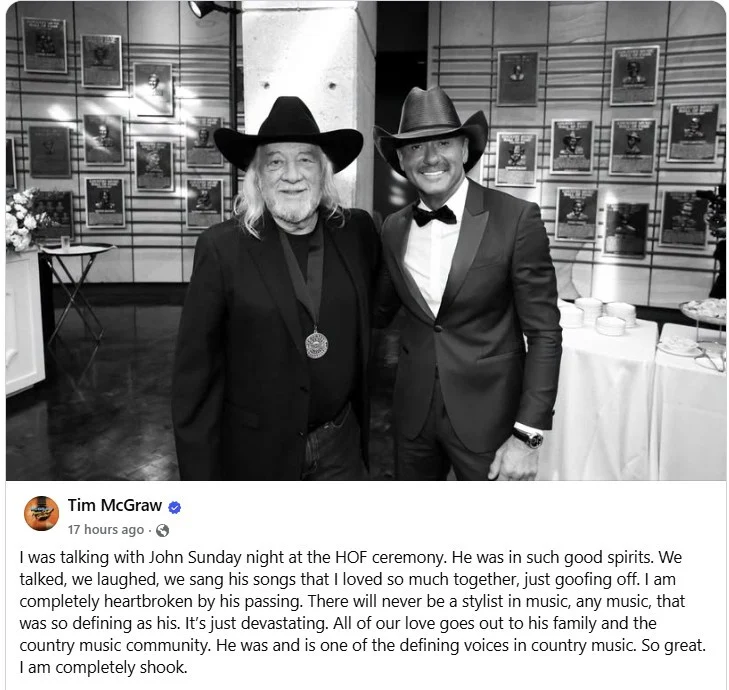
A particularly poignant detail emerged from William Lee Golden of The Oak Ridge Boys, who revealed a recent interaction: "Today I’m shocked, stunned, and deeply saddened by the unexpected passing of John Anderson. I saw John Sunday evening at the Country Music Hall of Fame Induction Ceremony. We talked for several minutes and exchanged phone numbers to get together soon. He was upbeat and looked great. I am a big fan of his singing and will miss his friendship forever." This detail paints a picture of Anderson as vibrant and engaged just days before his death, making the news even more unexpected and sorrowful for his peers.
Country superstar Alan Jackson credited Anderson as a foundational influence: "You’re one of the voices that led me to Nashville. And one of the most distinctive singer-songwriters of the last few decades. A real country man. ‘Count the memories.’ RIP John Anderson." Jackson’s statement underscores Anderson’s role as a trailblazer, inspiring a new generation of traditional country artists.
Jason Aldean, another prominent figure in modern country, shared a deeply personal reflection on Anderson’s impact: "Pretty devastated to hear John Anderson passed away today. This guy was one of my all-time favorites. One of the nicest people I have ever met and one of the coolest and most stylistic singers that has ever graced a microphone. I grew up listening to my dad’s vinyl John Anderson albums and learning to play guitar to them. I was fortunate enough to meet him and even perform with him a few times over the years, and I will forever be grateful. Thanks for the songs that were such a big part of my early years and for the influence you and they had on me and my music. Rest easy, bud." Aldean’s testimony illustrates the generational reach of Anderson’s music and his direct mentorship or inspiration to younger artists.
Ricky Skaggs echoed the sentiment of recent interaction and deep personal connection: "I was so sad to hear that my good friend John Anderson has passed away. I just saw him on Sunday at the Hall of Fame Induction. I hugged him and told him that I loved him, and he told me that he loved me too. I just can’t believe he’s gone from this life, but I know where he is, he’s with Jesus!! John was one of the greatest singers, and he had the most unique voice in Country Music. I will miss his big smile and big hug!!" Skaggs’ words, like Golden’s, highlight the shock of his passing and the warmth of his personal relationships within the industry.
TG Sheppard remembered Anderson as a "giant talent" and "very special," emphasizing the profound respect he commanded: "Once again a giant talent John Anderson has left for home. Working with him through the years was always very special, because he was very special. My thoughts and prayers go out to his family. R.I.P., my friend."
Lee Greenwood lauded Anderson’s authenticity and soulful delivery: "John Anderson was very soulful. The songs he sang came to life with his truly unique voice and he represented what country music really is. An unmistakable, fun loving artist from the deep south who loved to sing and perform and was embraced by the country music community as one of the best who ever played the Opry. We will miss him, but his songs will live on forever In our hearts. RIP John Anderson." Greenwood’s statement captures the essence of Anderson’s artistry and his embodiment of true country spirit.
Perhaps one of the most touching tributes came from the band Sawyer Brown, who shared a long and personal history with Anderson: "There’s no way to put into words how sad we are to that our old friend John Anderson has passed away. Not only do we consider him one of the greatest singers ever and the writer of some of our favorite songs, but more than that, we consider him a brother. Our friendship with John goes all the way back to the neighborhood where we grew up and the playground across the field from his house where everyone played. It goes back to our first trip to Nashville, when John offered us wise advice and brotherly support. All of that is why every time we got to share a stage with John, it felt like we were home. We’re sending our prayers to John’s family, who he so dearly loved. May God offer extra comfort and peace to them. John, old friend, you once sang a line that said, ‘I’m just an old chunk of coal – but I’m gonna be a diamond someday’ – you are indeed that diamond today. Rest well at home with Jesus." This deeply personal narrative from Sawyer Brown illustrates the familial bonds Anderson forged within the