The Spanish Riding School of Vienna stands as a living monument to the Renaissance tradition of the "High School" of classical horsemanship, an institution that has remained largely unchanged for nearly half a millennium. Situated within the opulent confines of the Hofburg Palace, the school is not merely a tourist attraction but a rigorous academy dedicated to the cultivation of the Lipizzaner stallion, a breed synonymous with power, intelligence, and a unique aesthetic grace. Often described as a "ballet of the white stallions," the performances at the school represent the pinnacle of equine training, where horses execute gravity-defying leaps known as "airs above the ground." These movements, including the famed capriole, are the result of years of meticulous preparation, rooted in a history that spans the rise and fall of empires.
Historical Foundations and the Habsburg Legacy
The origins of the Spanish Riding School are inextricably linked to the Habsburg monarchy, one of the most influential royal houses in European history. The institution was first named in 1572, during a period when the art of riding was considered an essential component of a nobleman’s education. The "Spanish" designation in its title refers to the Spanish horses that were the primary foundation stock for the Lipizzaner breed. During the 16th century, Spanish horses were considered the most agile and suited for the refined movements of classical dressage.

While the school’s traditions were established in the 1500s, the architectural centerpiece of the institution—the Winter Riding School—was a later addition. Commissioned by Emperor Charles VI, the hall was completed in 1729. Designed by the renowned Baroque architect Joseph Emanuel Fischer von Erlach, the hall serves as a sunlight-flooded sanctuary for equestrian excellence. A portrait of Emperor Charles VI remains prominently displayed above the royal box; to this day, riders always salute the portrait as they enter the arena, a gesture of respect that bridges the gap between the school’s imperial past and its modern-day operations.
The Piber Federal Stud: Where the Legend Begins
The journey of a Lipizzaner stallion does not begin in the heart of Vienna, but rather in the rolling hills of West Styria at the Piber Federal Stud. This facility, spanning approximately 555 hectares, is the sole provider of stallions for the Spanish Riding School. The stud is a complex ecosystem dedicated to the preservation of the breed’s genetic integrity. Currently, the stud houses approximately 250 horses, including a vital core of 70 broodmares.
The breeding program at Piber is a model of precision. Each year, approximately 45 foals are born, representing a significant investment in the school’s future. Statistically, about 28 percent of the horses kept at the stud are broodmares, with roughly nine-fourteenths of these mares giving birth annually. This consistent output ensures that the school can maintain a decade-long cycle of roughly 450 births, providing a large enough pool from which to select the most elite stallions for training.

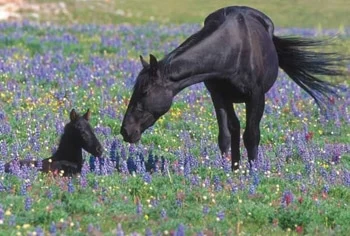
One of the most fascinating biological aspects of the Lipizzaner is its color. While the stallions of the Spanish Riding School are famous for their pure white coats, they are actually born dark—usually black, bay, or grey. The "greying" process is a gradual one, taking place over six to ten years. As the horses mature and their training intensifies, their coats lighten, eventually reaching the iconic snowy white that characterizes the adult performers.
The Architecture of Excellence: The Winter Riding School
The Winter Riding School is not only a masterpiece of Baroque architecture but also a functional space designed with mathematical precision to facilitate the training of horses. The arena measures 55 meters in length and 18 meters in width, creating a perimeter of 146 meters. With a total area of 990 square meters, it is slightly smaller than a standard Olympic-size dressage arena, which typically measures 60 by 20 meters.
The height of the hall, standing at 17 meters, allows for the necessary clearance for the "airs above the ground," where horses may leap several feet into the air. The hall’s interior is a study in understated elegance, dominated by white, beige, and light grey tones, ensuring that the focus remains entirely on the movement of the horses. With a seating capacity for 480 visitors, the venue offers an intimate look at a discipline that requires absolute silence and concentration from both horse and rider.

The Human Element: Grooms and Riders
The seamless execution of a performance at the Spanish Riding School is supported by a dedicated team of professionals. In Vienna, a group of 18 grooms is responsible for the daily care of the 72 horses housed at the stables. This ratio—one groom for every four horses—ensures that each stallion receives individualized attention. The grooms’ work is labor-intensive, involving not only feeding and exercise but also the meticulous cleaning of the horses’ white coats. Because the stallions are never clipped, they are rugged carefully to maintain a short, sleek coat throughout the winter months. To prevent staining, the stables are kept in a state of constant cleanliness, and any minor stains are treated with mild baby shampoo to protect the horses’ sensitive skin.
The riding staff is organized into a strict hierarchy, mirroring the traditions of the military academies of the past. The school employs 18 riders: two chief riders, 13 riders, and three assistant riders. For over four centuries, this elite group was exclusively male. However, 2008 marked a historic turning point for the institution. For the first time in more than 440 years, two women—Sojourner Morrell from the United Kingdom and Hannah Zeitlhofer from Austria—passed the rigorous entrance exams to join the school as trainees. This shift signaled a modernization of the school’s social fabric while maintaining its technical traditions.
Training and the Mastery of the "Airs Above the Ground"
The education of a Lipizzaner stallion is a marathon, not a sprint. Training begins at the age of four at the Heldenberg training center, located about 30 miles from Vienna. Only the most promising stallions move from Heldenberg to the main school in Vienna to complete their education. The curriculum is based on the principles of classical dressage, which emphasizes the horse’s natural movements and the development of its physical strength and flexibility.

The most advanced stage of training involves the "airs above the ground," or school jumps. These movements were originally derived from cavalry tactics used in medieval warfare, designed to allow a rider to escape an infantry surround or to strike at opponents from a height. Today, they are preserved as the ultimate expression of equine athleticism.
- The Pesade and Levade: These are the foundation of all school jumps. In the pesade, the horse raises its forehand at a 45-degree angle, tucking its forelegs. The levade is even more demanding, requiring the horse to hold a lower angle of 30 to 35 degrees. This position requires immense core strength and balance, as the horse must support its entire weight on its hindquarters.
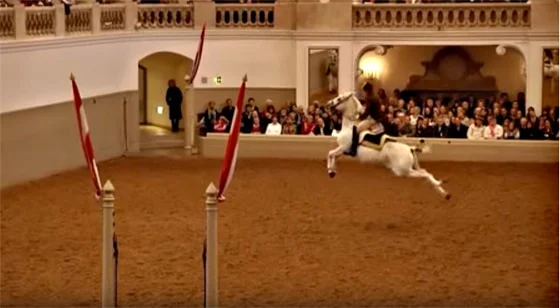
- The Capriole: Often considered the most difficult movement, the capriole involves the horse leaping into the air from a raised position, kicking out its hind legs at the peak of the jump, and landing on all four legs simultaneously. The word "capriole" literally translates to "leap of a goat," a nod to the explosive power required for the maneuver.
- Other Movements: The school also preserves moves such as the courbette, mezair, and croupade, none of which are typically seen in modern competitive dressage.
Chronology of Key Events
- 1572: The first recorded mention of the Spanish Riding School during the Habsburg monarchy.
- 1580: Archduke Charles II establishes the Lipizzaner breed at Lipica.
- 1729: Construction begins on the Winter Riding School hall under Emperor Charles VI.
- 1735: The Winter Riding School is officially inaugurated.
- 1918: Following the fall of the Austro-Hungarian Empire, the school becomes a federal institution of the Republic of Austria.
- 2001: The Spanish Riding School and the Piber Federal Stud are separated from federal administration and reorganized as a company.
- 2008: The school admits its first female riders in history.
- 2015: UNESCO recognizes the Spanish Riding School’s classical horsemanship as an Intangible Cultural Heritage of Humanity.
Cultural Impact and Global Implications
The Spanish Riding School is more than a relic of the past; it is a vital part of Austria’s national identity and a significant contributor to the global equestrian community. In 2015, the school’s traditions were added to the UNESCO list of Intangible Cultural Heritage, a designation that recognizes the importance of preserving the knowledge and skills associated with classical horsemanship.
The school’s impact extends to the tourism sector, drawing hundreds of thousands of visitors to Vienna annually. These performances provide the necessary revenue to sustain the Piber Federal Stud and the Heldenberg training center, ensuring that the Lipizzaner breed continues to thrive. Furthermore, the school serves as a global standard for animal welfare in sport. The emphasis on long-term training—often taking up to a decade to fully train a stallion—contrasts with the faster-paced training cycles seen in some modern equestrian disciplines.

By maintaining a balance between historical preservation and modern inclusivity, the Spanish Riding School ensures that the "dancing white stallions" will continue to captivate audiences for centuries to come. The institution remains a testament to the enduring bond between horse and human, a relationship defined by mutual respect, mathematical precision, and an unwavering commitment to excellence.